DrillBit AI has become a recognizable name in academic integrity, especially among universities, researchers, instructors, and students who need more than a basic plagiarism percentage. This DrillBit AI review 2026 examines how the platform works, what its reports actually show, how individual pricing is structured, and where its limitations matter. We also ran a practical test: AI-assisted text was rewritten with Ryter Pro, uploaded to DrillBit AI, and reviewed through both the summary dashboard and the detailed AI report.
The short version is that DrillBit AI is not just an AI detector. DrillBit AI combines similarity checking, AI-content estimates, grammar or writing-quality signals, document reporting, and academic workflows. In our sample, the Ryter Pro rewrite received a 0.00% AI score from DrillBit AI, with no AI-matched blocks. That is a useful result, but it is one test rather than a universal guarantee. DrillBit AI itself describes AI detection as probabilistic evidence that should be interpreted with human judgment.
Quick Verdict
DrillBit AI is best suited to academic and institutional review. DrillBit AI gives reviewers a continuous AI percentage, highlighted passages, similarity information, and downloadable reports instead of reducing a document to a vague pass or fail. The platform also supports individuals through pay-per-page access, which makes DrillBit AI more approachable for students and independent researchers who do not have an institutional login.
The strongest part of DrillBit AI is the combined workflow. A reviewer can examine similarity, AI probability, grammar, sources, and document-level evidence in one place. The main weakness is shared by every detector: DrillBit AI can estimate linguistic patterns, but it cannot know authorship with certainty. A score should begin a review, not end one.
What Is DrillBit AI?
DrillBit AI is the AI-content detection layer within DrillBit's broader plagiarism and content-integrity platform. DrillBit AI is designed for educational institutions, schools, publishers, corporations, learning platforms, consortiums, researchers, and individual users. Its institutional reach is a meaningful distinction because DrillBit AI is built around submissions, classrooms, folders, repositories, and formal reports rather than a simple public text box.
For individual users, DrillBit AI accepts common document formats such as PDF, DOCX, and TXT. A document can be checked for similarity, likely AI-generated content, and writing quality. For institutions, DrillBit AI can sit inside academic workflows through LMS and API integrations. Current materials describe support for Moodle, Canvas, Blackboard, Brightspace, LTI-based setups, and custom integrations.
How DrillBit AI Detection Works
According to DrillBit's published technical explanation, DrillBit AI uses a multi-stage pipeline. It extracts and cleans text, verifies language, measures linguistic features, classifies those signals, produces a continuous score, and presents the result for human review. DrillBit AI looks for patterns such as low perplexity, low burstiness, stylometric uniformity, unusually smooth semantic transitions, repeated n-gram structures, and flat lexical diversity.
This approach explains why DrillBit AI works better with substantial documents than with tiny samples. The provider states that its engine is optimized for documents of 500 words or more, while texts under 200 words may produce lower-confidence results. DrillBit AI also defines a broad uncertain zone rather than pretending every mixed document is obviously human or AI. Scores in that middle range deserve closer inspection.
What Appears in a DrillBit AI Report?
A DrillBit AI report begins with submission metadata and a headline AI Text percentage. It then separates estimated AI text from human text and highlights sentences that DrillBit AI considers likely machine-generated. The downloadable report can include the author, title, submission ID, document type, date, page count, matched blocks, and highlighted document content.
This presentation is useful because DrillBit AI shows reviewers where the concern comes from. A percentage alone can be misleading. Highlighted blocks let an instructor compare suspicious sentences with the rest of the paper, ask the author about their process, and examine whether the writing style changes abruptly.
DrillBit AI Features
- AI content detection: DrillBit AI estimates the proportion of likely AI-assisted text and highlights candidate passages.
- Similarity detection: DrillBit AI sits alongside source matching for internet pages, journals, repositories, theses, dissertations, and institutional collections.
- Writing-quality analysis: DrillBit AI workflows may include grammar, readability, vocabulary, sentence, and structural indicators.
- Downloadable reports: DrillBit AI produces structured evidence suitable for academic review and record keeping.
- Classroom and folder management: DrillBit AI supports repeated submissions and organized institutional workflows.
- LMS and API integration: DrillBit AI can connect with learning platforms instead of forcing instructors into a separate process.
- Multilingual focus: DrillBit AI is positioned for international and Indian regional language contexts.
DrillBit AI Accuracy and Limitations
DrillBit AI publishes validation figures for human detection, AI detection, and overall system performance. Those figures are useful context, but they should not be treated as a promise for every discipline, language, model, document length, or editing style. DrillBit AI results can change as AI models evolve and as writers combine generated text with manual revision.
The responsible interpretation is the one DrillBit AI recommends: use the score as an indicator. A high DrillBit AI score is not proof of misconduct, and a 0% result is not proof that no AI assistance occurred. Instructors should consider drafts, citations, assignment rules, version history, oral explanation, and the student's established writing style. This caution makes the platform more credible than marketing that claims perfect certainty.
DrillBit AI Pricing for Individuals
DrillBit AI individual access uses a pay-per-page model rather than a mandatory monthly subscription. At the time of this review, the published examples included 25 pages for ₹400, 100 pages for ₹960, and 500 pages for ₹3,600. Larger bundles reduce the per-page cost, and purchased pages are described as non-expiring.
This pricing model makes DrillBit AI practical for occasional users. A student checking one dissertation draft may prefer page credits over another recurring subscription. Heavy users should calculate total pages carefully, while institutions will generally need a separate arrangement based on scale, integrations, repositories, and workflow requirements.
Ryter Pro Test: Can Humanized Text Pass DrillBit AI?
For the practical part of this DrillBit AI review, we started with AI-assisted text about healthcare technology. The original draft had the smooth structure and predictable phrasing that detectors often associate with generated writing. We then used the Ryter Pro AI Humanizer to rewrite the passage into more natural language while preserving its main meaning.
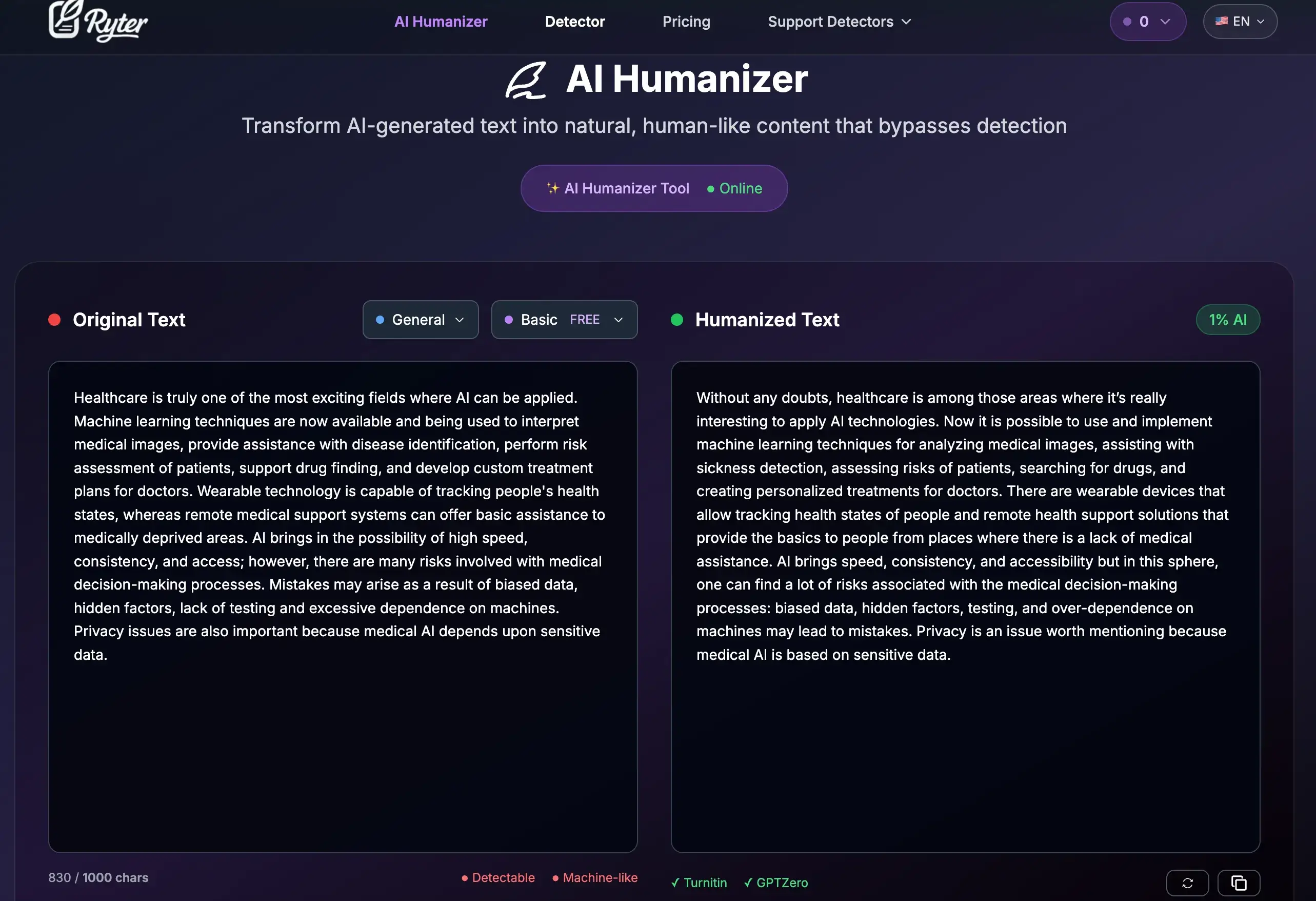
The Ryter Pro screenshot shows the source on the left and the humanized version on the right. The rewrite changes sentence construction, rhythm, vocabulary, and transitions rather than only swapping isolated synonyms. Ryter Pro displayed a 1% AI indicator for this output. We then placed the rewritten text into a two-page document and submitted it to DrillBit AI.
DrillBit AI Summary Result
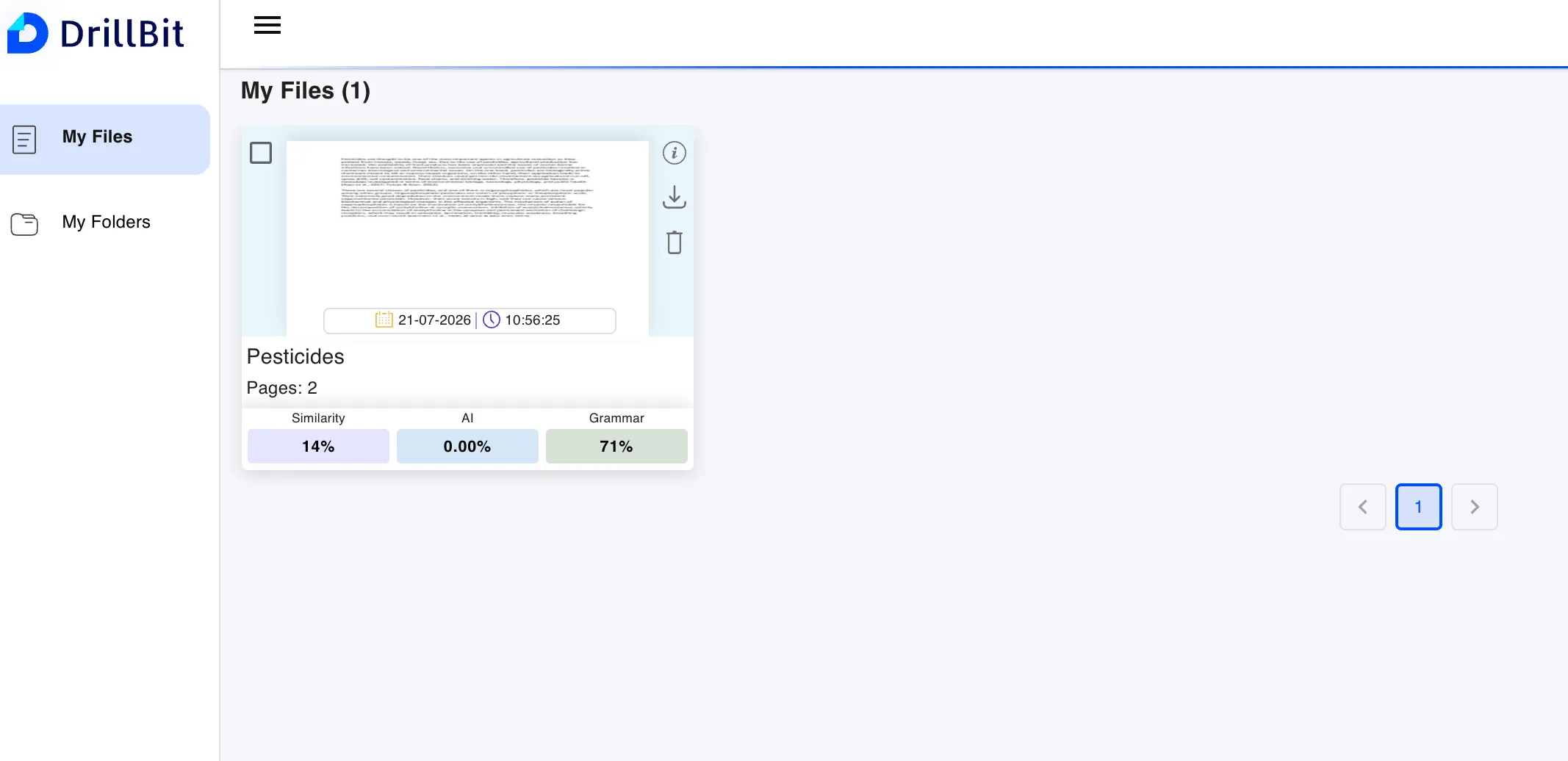
The DrillBit AI dashboard returned three visible metrics: 14% similarity, 0.00% AI, and 71% grammar. The 14% similarity figure should not be confused with AI detection; it reflects source overlap. The central result for this test is the 0.00% DrillBit AI score.
Detailed DrillBit AI Report
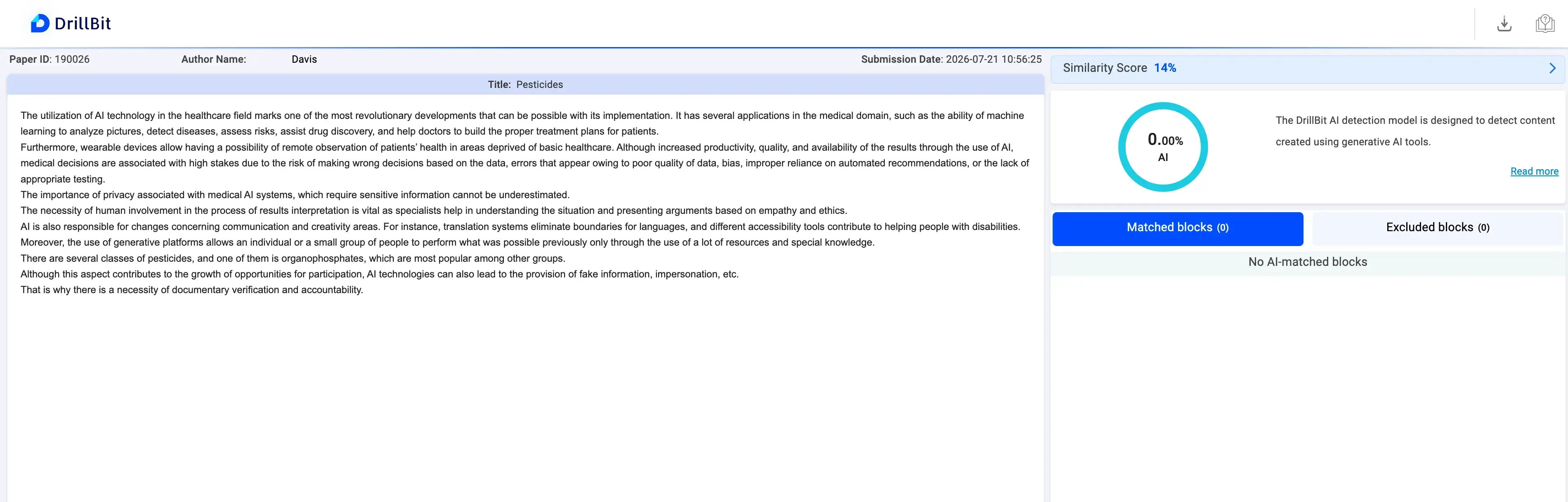
The detailed DrillBit AI view confirmed the summary. It displayed 0.00% AI and reported no AI-matched blocks. For this specific healthcare passage, Ryter Pro successfully changed the signals DrillBit AI was evaluating while keeping the text readable and recognizable in meaning.
This result does not mean every Ryter Pro output will receive the same DrillBit AI score. Document length, source model, subject, language, prompt, humanizer mode, and later editing can all affect detection. The sensible workflow is to humanize AI text, read it carefully, verify every factual claim, add genuine knowledge, and respect the rules governing the document.
Humanize AI Text with Ryter Pro
How to Improve AI-Assisted Text Before a DrillBit AI Check
- Start with accurate source material. DrillBit AI detection and similarity are separate concerns, so cite sources properly before rewriting.
- Humanize the complete passage. Ryter Pro can revise structure and rhythm more deeply than manual synonym replacement.
- Add your own reasoning. Include examples, qualifications, evidence, and conclusions you can defend.
- Review meaning and facts. A lower DrillBit AI score does not make an inaccurate claim acceptable.
- Check institutional policy. Disclose AI assistance when required and never use rewriting to misrepresent authorship.
DrillBit AI Pros and Cons
Pros
- DrillBit AI combines AI detection, similarity, and writing-quality information.
- DrillBit AI provides highlighted evidence and downloadable reports.
- DrillBit AI supports both institutional workflows and individual page purchases.
- DrillBit AI offers LMS, LTI, plugin, and API integration options.
- DrillBit AI explicitly tells reviewers to use human judgment.
Cons
- DrillBit AI cannot prove authorship or misconduct from a percentage.
- DrillBit AI may have lower confidence on very short documents.
- DrillBit AI institutional pricing is not as simple as the individual page bundles.
- DrillBit AI reports still require a trained reviewer who understands false positives and mixed authorship.
- DrillBit AI detection results can change as language models and rewriting tools evolve.
DrillBit AI vs Ryter Pro
| Use Case | Best Fit | Why |
|---|---|---|
| Estimate AI-generated content | DrillBit AI | Provides an AI percentage and highlighted evidence. |
| Check plagiarism and source overlap | DrillBit AI | Includes similarity reports and source-level matches. |
| Humanize AI-assisted writing | Ryter Pro | Rewrites sentence structure, rhythm, and wording. |
| Improve a draft before review | Ryter Pro | Helps produce clearer, more natural prose. |
| Manage institutional submissions | DrillBit AI | Supports classrooms, folders, LMS connections, and reports. |
DrillBit AI and Ryter Pro are not direct substitutes. DrillBit AI evaluates documents; Ryter Pro rewrites them. A responsible writer can use Ryter Pro to improve clarity and remove generic machine phrasing, while an institution can use DrillBit AI as one piece of a broader review process.
Who Should Use DrillBit AI?
DrillBit AI makes the most sense for universities, schools, academic libraries, publishers, researchers, instructors, and learning platforms that need repeatable document analysis. Individual students and writers may also find DrillBit AI useful when they want to inspect similarity, likely AI content, and writing quality before submitting a document.
DrillBit AI is less suitable for anyone expecting a magical truth machine. The platform offers evidence, not certainty. Its value comes from combining reports with knowledgeable review. Likewise, Ryter Pro should be used to improve genuine work, not to conceal misconduct or skip the learning process.
Frequently Asked Questions
What does DrillBit AI detect?
DrillBit AI estimates whether text contains patterns associated with AI writing. DrillBit AI also sits alongside plagiarism similarity and writing-quality analysis in the broader platform.
Is DrillBit AI accurate?
DrillBit AI publishes validation results and explains its detection methodology, but no AI detector is perfect. DrillBit AI scores should be interpreted with document context and human review.
Can Ryter Pro pass DrillBit AI detection?
In our documented sample, Ryter Pro humanized text received 0.00% AI from DrillBit AI, with no AI-matched blocks. Results can vary, so this should be treated as a test result rather than a guarantee.
Does DrillBit AI check plagiarism too?
Yes. DrillBit AI is part of a broader content-integrity platform that includes similarity detection, source breakdowns, writing-quality analysis, and downloadable reports.
Does DrillBit AI have individual pricing?
Yes. DrillBit AI offers individual page bundles without a required monthly subscription, and the published materials state that purchased pages do not expire.
Final Verdict
DrillBit AI is a serious academic-integrity platform with more depth than a basic browser detector. Its combined similarity, AI, grammar, reporting, and workflow features make DrillBit AI especially relevant for institutions. Its pay-per-page individual option also gives students and researchers a practical way to review documents without a recurring plan.
Our Ryter Pro test produced a clear outcome: DrillBit AI reported 0.00% AI, 14% similarity, 71% grammar, and no AI-matched blocks after the text was humanized. That makes Ryter Pro a useful writing tool for turning stiff AI-assisted drafts into more natural prose. The final responsibility still belongs to the writer: verify facts, add original thinking, cite sources, and follow applicable AI-use rules.