
Searching for the best AI humanizer for students usually starts with a simple worry: an essay or discussion post sounds unlike the person who submitted it. The wording may be polished, but every paragraph has the same rhythm. Important claims feel broad, transitions repeat, and the writer cannot explain why a particular sentence is there. A humanizer can help with that problem, but only when it is used as an editing step rather than a substitute for thinking.
This review looks at the job from a student's point of view. I compared the qualities that matter before a submission, designed a three-part test pack, and ran a short student-style passage through Ryter Pro's public AI Humanizer page. The result was useful, but it was not magic. The rewrite kept the central idea and reported 0% AI on the page, while a few word choices still needed a student's judgment. That distinction is the difference between a helpful writing aid and a risky one.
Quick answer
The best AI humanizer for students is the one that makes a draft clearer without erasing the student's argument, evidence, or normal voice. A low detector score alone is not enough. A rewrite that changes a qualification, invents a source, or turns a careful claim into a confident one creates a new problem.
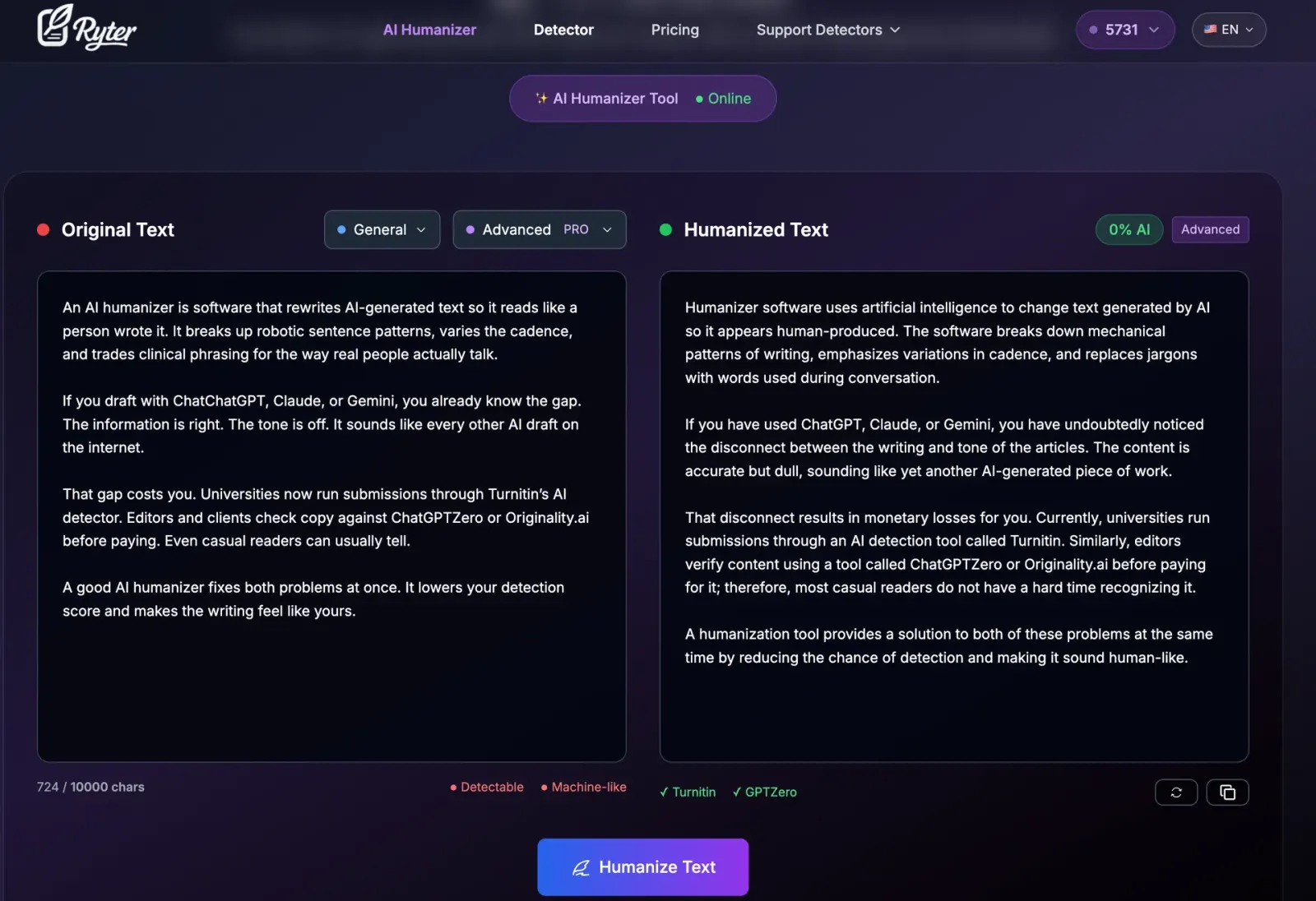
For students who want a focused rewrite workflow, Ryter Pro is the strongest fit in this review. Its public page makes the basic path easy to understand: paste a passage, choose a writing mode, run the humanizer, and inspect the result beside the original. In my short test, the page reported 0% AI and displayed Turnitin and GPTZero indicators. I would still treat that result as a checkpoint, not a promise about a university report or a future detector update.
Students should also read their course or institution policy before using any AI writing tool. Some policies allow spelling, grammar, or accessibility support but restrict generated prose. Others require disclosure. A humanizer cannot turn an unauthorized use of AI into an authorized one.
What students should evaluate
1. Does the rewrite sound like a person, not a template?
Human writing is not uniformly casual. A student may use formal language in a literature review, then write a shorter and more direct sentence when explaining a personal observation. Good editing preserves that range. It should reduce repeated openings and stiff transitions without adding slang that does not fit the assignment.
Read the output aloud. If every sentence has a similar length, if each paragraph ends with a tidy summary, or if the wording sounds more sophisticated than the student's usual work, the tool has moved too far. The best AI humanizer for students should give them a draft they can honestly understand and revise, not a voice they have to imitate.
2. Does it preserve the argument?
Meaning preservation has several layers. The broad topic needs to stay the same, but so do the direction of the claim, the strength of the evidence, the time period, and the relationship between cause and effect. A rewrite can be grammatically clean and still make a real mistake by changing may to will or by dropping a limitation from a research finding.
Students should compare the original and revised text line by line. Pay special attention to numbers, named theories, quoted material, citation markers, definitions, and technical terms. A humanizer is not a fact checker. It is also not a plagiarism checker. Those jobs still belong to the writer and the appropriate review tools.
3. Are detector results being treated as signals?
AI detectors estimate patterns. They do not read a student's mind, inspect every draft, or prove who wrote a sentence. The same passage can receive different results from different systems, especially when it is short, heavily edited, written by a multilingual student, or built around predictable academic language. Turnitin's own guidance says its AI report can misidentify human, AI-generated, and AI-paraphrased text, so it should not be the sole basis for adverse action.
That does not make detector feedback useless. It can show that a passage has a repetitive cadence or generic wording worth revisiting. It can also help a student document the editing process. The responsible question is not how to chase a perfect number. It is whether the final work is accurate, permitted, and genuinely understood by the person submitting it.
4. Are the limits clear?
Free access often comes with character caps, daily limits, or restricted modes. Those details matter when an essay is several pages long. A tool should tell you when a passage is too long, what mode is active, and whether a rewrite consumed an allowance. Privacy information matters too. Students should avoid pasting confidential research data, unpublished participant information, or another person's personal details into a service without permission.
Our test design
A useful comparison needs more than one polished paragraph. I designed three samples that stress different parts of a student workflow. The samples are intentionally ordinary. They include the kind of wording students encounter in assignments, rather than a dramatic prompt built to make a humanizer look impressive.
| Sample | What it tests | What to inspect after rewriting |
|---|---|---|
| Academic argument | Formal reasoning, a qualified claim, and a citation placeholder | Whether the qualification and citation position remain intact |
| Campus blog post | First-person voice, mixed sentence lengths, and a practical example | Whether the personal detail remains believable and specific |
| Lab or project summary | Technical terms, a measured result, and a process description | Whether terminology, units, and cause and effect survive |
Sample A: academic argument
Spaced repetition can help students retain material because it makes them retrieve information after a delay rather than recognize it immediately on a page. The method is not a replacement for understanding, and it may be less useful when a course asks students to apply a concept in an unfamiliar setting. A short review schedule can work better when each session includes a question, an example, and a note about what remains unclear. One study reported improved delayed recall among students who used repeated retrieval, but the result should be read alongside the study's sample size and testing conditions [citation placeholder].
This sample tests whether a rewrite keeps the difference between retention and understanding. It also tests whether a citation placeholder stays attached to the claim it supports. If a tool removes the caveat or moves the reference to the wrong sentence, the output needs correction.
Sample B: campus blog post
My first week in the campus library was less productive than I expected. I kept choosing a seat near the entrance, then looked up whenever someone came through the doors. On Wednesday I moved to a smaller room on the second floor and left my phone in my backpack. The change was not dramatic, but I finished a reading response before dinner. I still prefer working at home for short tasks, while the library helps when I need two quiet hours and a clear reason to stay at my desk.
There is no correct detector score for this passage. The useful question is whether a rewrite keeps the small, slightly uneven details that make it sound like a student's observation. Replacing them with broad advice about productivity would produce smoother copy and a worse piece of writing.
Sample C: lab or project summary
Our prototype measured room temperature every 30 seconds for 24 hours. The sensor recorded a median of 21.8 C, but readings near the window rose when direct sunlight reached the enclosure. We removed those readings from the comparison only after checking the raw log and noting the reason in the methods section. The revised average was lower than the first calculation, which changed the discussion but did not change the main conclusion. The next test should use a shield around the sensor and compare two rooms under the same sampling interval.
This sample is harder for a careless rewriter because the numbers and the sequence of decisions carry meaning. It also contains an honest limitation. A student should reject any output that changes the temperature, deletes the exclusion rule, or makes the prototype sound more reliable than the test supports.
How I scored the writing
I use a simple 25-point review rather than inventing a single magic percentage. Each category receives 0 to 5 points:
- Meaning preservation: The rewrite keeps the original claim, direction, and qualifications.
- Readability: Sentences are clear and the rhythm does not feel mechanically uniform.
- Evidence safety: Numbers, citations, quotations, and technical terms remain available for verification.
- Voice: The output fits the assignment and does not sound like a generic replacement author.
- Practical control: The student can compare, edit, and reuse the result without unnecessary friction.
This rubric is deliberately different from a detector score. A passage can receive a low AI estimate and still score poorly because the rewrite damaged the argument. Conversely, a clear student draft can be worth keeping even when a detector produces an uncomfortable result. Students need both kinds of feedback, but they should not confuse them.
Live Ryter Pro test
For the browser test, I used a short paragraph about balancing schoolwork with a part-time job. It mentioned money, work experience, long shifts, reading, sleep, concentration, classroom participation, a weekly schedule, realistic deadlines, rest, and communication with an employer or instructor. The anonymous public page accepted 500 characters in its Basic FREE mode, so the sample was trimmed to the visible limit.
| Check | Observed result | My reading |
|---|---|---|
| Input limit | 500 of 500 characters shown | Enough for a short paragraph, not a full essay |
| Rewrite status | Humanized output returned in seconds | Fast enough for a paragraph-by-paragraph workflow |
| Detector display | Page displayed 0% AI and Turnitin and GPTZero indicators | Useful as a product signal, not a universal guarantee |
| Meaning | Main points and order remained recognizable | Pass, after a human line check |
| Word choice | Some phrases became more formal, such as workplace supervisor and tutors | Readable, but a student may want a more natural local choice |
The rewrite changed the opening to mention numerous students juggling study and part-time work. It kept the basic tradeoff between income, experience, time, and rest. It also kept the recommendation to plan ahead and communicate when work becomes difficult. The weak spot was not a factual error. It was register. Workplace supervisor and tutors sounded slightly less natural than the original wording for this particular paragraph.
That is a good result for a first pass. It gives the student something to edit, and it does not ask them to accept every sentence blindly. I would not describe one browser result as proof that a piece will pass every detector. I would describe it as evidence that Ryter Pro can make a short, generic passage less uniform while leaving the writer with a manageable review job.
Where Ryter Pro fits
Students often group several different products under the word humanizer, but the tools behave differently.
Grammar and tone assistants
These tools are good at correcting an awkward sentence, shortening a paragraph, or adjusting formality. They are useful when the student already has a draft and wants local suggestions. They may do little to change the overall rhythm of a long AI-generated passage.
Basic paraphrasers
Paraphrasers can show alternative wording quickly. The tradeoff is that synonym changes may leave the original sentence pattern intact. They can also select a word that is technically related but wrong for the subject.
Aggressive detector-focused rewriters
These services may make bigger changes. Bigger changes can lower visible repetition, but they also create more opportunities for a lost qualifier, a strange phrase, or a changed fact. A student who needs to rebuild half the output has not saved much time.
Large writing platforms
Some platforms put a humanizer inside a broader system for research, article generation, search optimization, and publishing. That can be convenient for a content team. A student who only needs to revise a paragraph may prefer a focused page with fewer decisions and a clear before-and-after view.
Ryter Pro fits the last category: a focused AI Humanizer that is quick to test and simple to compare against the source. The public page I used offered a Basic FREE mode with a 500-character limit and a longer logged-in allowance. Those limits can change, so check the live page before planning a full assignment around them. You can start with the Ryter Pro text humanizer and use the same sample pack before deciding whether it fits your writing process.
How students can use a humanizer responsibly
- Write the substance first. Add your position, examples from class, source notes, and the details you can defend. A tool cannot supply your actual understanding.
- Keep the original version. Save the draft before humanizing it. This makes it easier to recover a definition, citation, or phrase that the rewrite changed.
- Process representative sections. Test a passage that contains the same terminology and level of formality as the rest of the assignment. A casual introduction cannot predict what will happen to a methods section.
- Use the lightest useful rewrite. If a sentence is already clear, leave it alone. Stronger rewriting is appropriate only when the paragraph truly has repetitive or mechanical structure.
- Compare every important detail. Check figures, dates, names, units, quotations, citations, and words such as may, can, often, and suggests.
- Add your own revision. Replace generic examples with the point raised in class, explain why a source matters, or qualify an argument in a way that reflects your reading.
- Check the policy. If AI assistance must be disclosed, disclose it. If humanization is not allowed for the assignment, do not use a detector result as a reason to ignore that rule.
What a humanizer cannot repair
A humanizer cannot verify that a journal article exists. It cannot tell whether an interpretation matches the assigned novel, whether a calculation used the correct formula, or whether a paragraph accidentally copies a source too closely. It may improve a false statement along with the rest of the prose, which can make the error harder to notice.
It also cannot give a student a personal writing history. Drafts, notes, comments from a tutor, and version history are often more useful when a school asks how a submission was produced. A clean detector score does not replace those records. The best AI humanizer for students should fit inside an honest writing process, not become the process.
A submission checklist
Before sending an assignment, ask:
- Can I explain the main argument without reading the paragraph again?
- Did the rewrite preserve every citation marker, number, definition, and limitation?
- Does the tone match the course and my normal level of writing?
- Did I verify sources instead of trusting polished wording?
- Did I check the course policy and record AI assistance if required?
- Did I compare the final version with the original and make my own edits?
If the answer to any of these is no, another pass through a humanizer is not the next step. Read the source, talk to the instructor or writing center, and fix the underlying problem.
Frequently asked questions
What is the best AI humanizer for students in 2026?
There is no universal winner for every assignment. For students who want a focused before-and-after workflow, Ryter Pro is a practical option to test. Judge it with your own academic, blog, and technical samples, then review meaning and policy compliance before using the output.
Can an AI humanizer guarantee a result on Turnitin or GPTZero?
No. Detector models change, different services measure different signals, and short or multilingual writing can behave unpredictably. Ryter Pro's live page reported 0% AI and showed Turnitin and GPTZero indicators in my short test, but that is an observed result from one passage, not a guarantee for every assignment.
Is using an AI humanizer for school allowed?
It depends on the course and institution. Some policies allow limited assistance for editing or accessibility, while others prohibit generated or transformed prose. Check the written policy and disclose assistance when required. A humanizer should not be used to conceal unauthorized work.
Will a humanizer preserve my citations?
It may leave citation markers in place, but you still need to check where each citation sits and whether the rewritten claim says the same thing. Verify every reference manually. A humanizer does not prove that a source supports a sentence.
Is Ryter Pro useful for a full essay?
It can be useful paragraph by paragraph, but the public Basic FREE mode used in this review showed a 500-character limit. Longer access and current plan details may differ. Test one representative section first, keep the original, and avoid processing the entire essay before you know how the wording behaves.
Final summary
The best AI humanizer for students is not the service with the loudest promise or the lowest single detector number. It is the one that helps a student produce clearer prose while keeping the argument, evidence, limits, and personal responsibility intact.
Ryter Pro performed well as a focused first rewrite in the live short-input test. It returned a readable passage, preserved the main idea, and displayed 0% AI with Turnitin and GPTZero indicators. It also produced a few formal word choices that still needed editing. That is the honest standard I would use: helpful acceleration, followed by careful human review. For a controlled test of your own draft, visit the Ryter Pro AI Humanizer, process a representative paragraph, and decide based on clarity and accuracy before you decide based on any score.