
You paste an AI draft into a humanizer, click rewrite, and get back a page full of different words. Then an AI detector still flags it. Worse, the new version sounds awkward and has quietly changed one of your claims. That experience leads many people to conclude that AI humanizers do not work.
The conclusion is understandable, but it is incomplete. A humanizer can fail in several ways. It may fail to change a detector score, fail to preserve meaning, or fail to sound like the person whose name appears on the page. Those are separate problems, and chasing only the score often makes the other two worse.
This article explains why basic AI humanizers struggle, what detector research tells us, and how to build a better editing process. The aim is not to promise an undetectable button. No honest tool can guarantee the verdict of every detector. The useful goal is a draft that is accurate, readable, specific, and recognizably yours.
What does it mean when an AI humanizer does not work?
Most complaints fall into three buckets. First, the rewritten text receives the same or a higher AI score. Second, it passes one detector but fails another. Third, it sounds less natural than the original draft. A tool can also produce a low score while damaging facts, citations, or tone. Calling that a success makes little sense.
This distinction matters because AI detection and writing quality are not the same measurement. A detector estimates whether patterns in a document resemble patterns found in its training data. It does not interview the author, inspect revision history, or verify where each idea came from. A lower score can be useful feedback, but it is not proof of authorship or quality.
Why most AI humanizers fail
They change vocabulary while keeping the same plan
Cheap rewriting systems often replace words, move a clause, and adjust a few transitions. The paragraph still follows the same tidy sequence. Every sentence has a similar shape. The conclusion repeats the introduction in slightly grander language. A detector may still notice those broader patterns, while a human reader notices that the prose feels stiff.
Consider the sentence, "Regular exercise provides numerous benefits for physical and mental health." Replacing "numerous benefits" with "many advantages" does not add a point of view, a concrete example, or a reason for the reader to care. It is the same generic sentence wearing a new shirt.
They are asked to preserve everything and change everything
A humanizer has two jobs that pull in opposite directions. It must keep the meaning, terminology, names, and evidence intact. At the same time, it must make the text substantially different. Weak tools solve the conflict by making shallow substitutions. Aggressive tools may alter dates, reverse qualifications, invent transitions, or replace precise technical language with a loose synonym.
This is why domain language needs special care. In medicine, law, engineering, and academic work, two words that look similar in a thesaurus may not be interchangeable. A rewrite that lowers a detector score but changes the claim has failed.
They add random noise instead of a real voice
Some tools treat human writing as a collection of quirks: shorter sentences, contractions, unusual words, and occasional fragments. Mixing those features into a draft can change its statistical profile, but random variation is not voice. Voice comes from repeated choices. A person has preferences about what deserves detail, what can be skipped, how certain a claim should sound, and which examples are worth using.
A paragraph becomes more human when it contains information that came from a person. That might be a firsthand observation, a limitation discovered during testing, a disagreement with the common advice, or a specific number pulled from the author's records. Artificial messiness cannot replace that material.
One writing style cannot fit every genre
A personal newsletter can use asides and contractions. A lab report should be controlled and precise. Customer support copy needs direct instructions, while a product review should document what was tested. A universal humanizer often pushes all four toward the same casual middle. The result may be fluent, but it sounds wrong for the setting.
Genre also affects detector behavior. Formal writing naturally contains repeated terminology and predictable sentence structures. Writers who use English as an additional language may choose common constructions more often. These qualities can resemble the signals a classifier learned from machine text, which is one reason a score needs context.
They optimize for one detector snapshot
Detectors disagree because they use different models, thresholds, training sets, and document rules. They also change. A rewrite tuned to one detector today may perform differently after that detector updates, or it may fail immediately in another service.
The research shows how unstable this contest can be. A 2024 ACL paper that stress tested detectors under editing, paraphrasing, prompting, and co-writing attacks found an average performance drop of 35 percent across the detectors it studied. That finding does not prove that every humanizer works. It shows that detector results depend heavily on the attack, model, and test conditions. You can read the ACL detector robustness study for the full methodology.
The other side of the contest is moving too. New detection methods are trained on paraphrased and edited samples. Once many tools produce the same style of rewrite, that style can become a recognizable class of its own. This is an arms race, not a stable certification test.
They cannot supply provenance
A clean detector score cannot show how a document was made. In a classroom or workplace dispute, notes, drafts, tracked changes, sources, and the ability to explain the argument are stronger evidence than a screenshot from a detector. Basic humanizers do not create that evidence. In some cases they erase it by replacing the author's original phrasing with a uniform rewrite.
Detector vendors also caution against treating scores as verdicts. Turnitin's current guidance says false positives are possible and notes that results below 20 percent have a higher incidence of false positives, so that range is shown with an asterisk rather than an exact percentage. Its guidance states that the report should not be the sole basis for adverse action. See Turnitin's AI Writing Report guidance.
What detector research changes about the question
People often ask whether an AI humanizer can beat a detector. A better question is whether the finished document can survive three kinds of review: a factual check, a close read by a person who knows the subject, and the automated checks used in that setting.
Human readers catch signals that are hard to compress into one score. In a 2025 ACL study, frequent users of ChatGPT reviewed 300 nonfiction articles. A majority vote among five experienced annotators misclassified only one article, outperforming most of the automated detectors tested in the study, including when the text had been paraphrased or humanized. Their explanations referred to wording, but also to originality, formality, and clarity. The study on human detection of AI writing is a useful reminder that changing surface statistics is not enough.
For publishers, search performance adds another test. Google's guidance does not say that AI-assisted content is automatically bad. It asks publishers to focus on accuracy, quality, relevance, and original value. Generating many low-effort pages without adding value may violate spam policies. That makes a detector-only workflow especially shortsighted. Read Google's guidance on generative AI content for the current policy.
A better way to humanize AI text
- Start with source material. Collect your notes, examples, claims, links, and required terminology before asking for prose. A model works better when it expands real material instead of inventing a generic answer from a short prompt.
- Mark what cannot change. Protect quotations, product names, legal language, figures, and cited conclusions. Check every protected item after rewriting.
- Rewrite by purpose, not by sentence. Ask what each paragraph is doing. If two paragraphs repeat the same point, combine them. If a claim lacks an example, add one from your own work. Information order matters more than synonym choice.
- Use a humanizer as an editing pass. A capable tool can help break repetitive sentence shapes, remove stock transitions, and produce a cleaner base draft. It should not replace the author, the fact check, or the final read.
- Read the result aloud. Awkward paraphrases become obvious when spoken. Watch for words you would never use, perfect paragraph symmetry, and conclusions that say nothing new.
- Keep the evidence of your process. Save the outline, source list, early draft, and meaningful revisions. This is useful editorial discipline and may help if authorship is questioned.
- Treat detector scores as diagnostics. If a section is flagged, inspect it for repetition, generic claims, and copied phrasing. Do not keep rewriting a strong, accurate paragraph merely to chase zero.
Where Ryter Pro fits
Ryter Pro is most useful in the fourth step: turning a stiff AI-assisted draft into a more natural editing base. Its text humanizer works beyond isolated synonym replacement and revises sentence structure, pacing, and phrasing while aiming to preserve the original point. You still need to review facts and add your own experience. That last part cannot be automated.
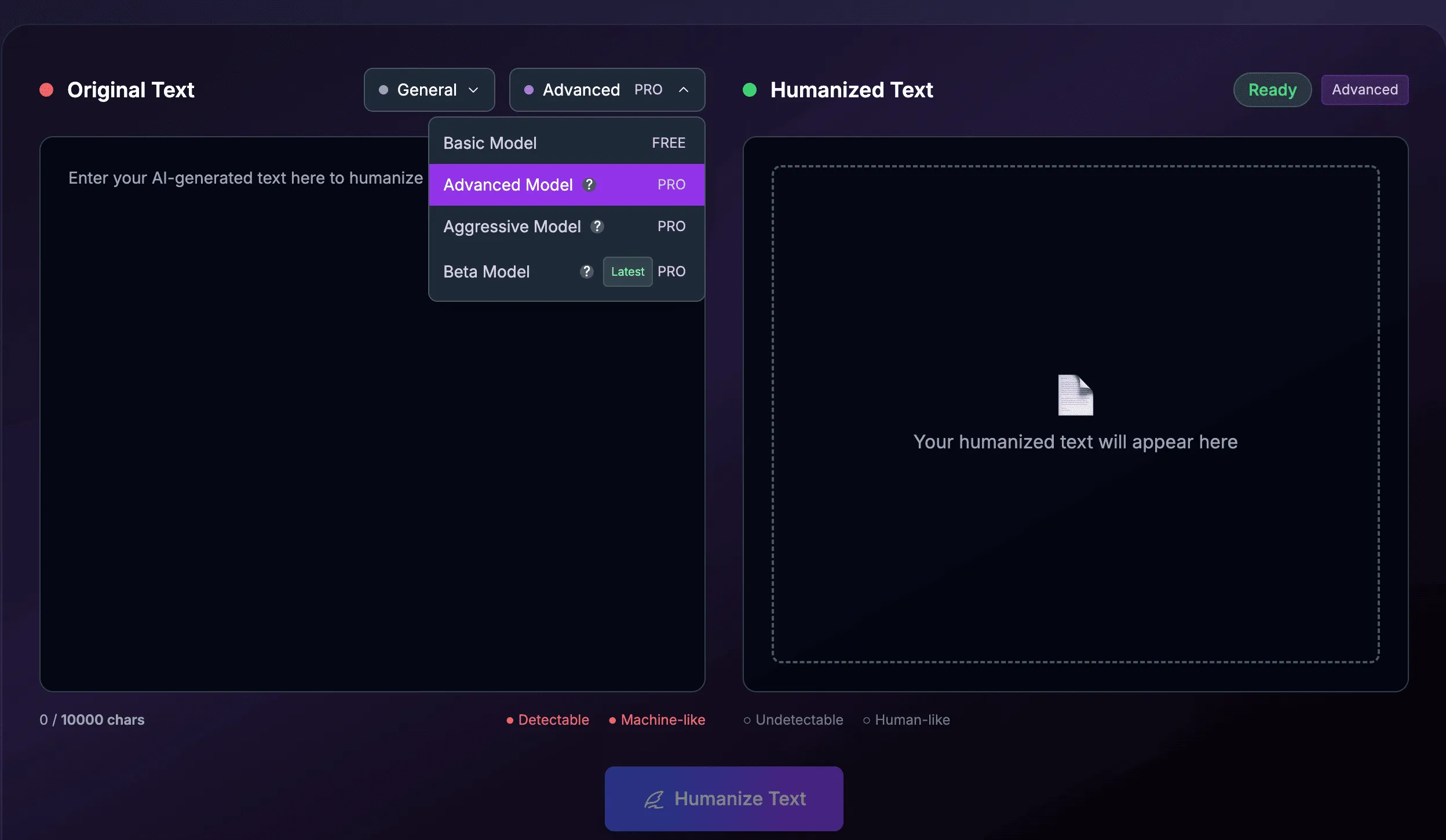
Try the Ryter Pro text humanizer
A sensible test is to humanize one section, place it beside the source, and compare both line by line. Did the rewrite retain the claim? Does it fit the intended reader? Can you defend every sentence? Continue only if the answer is yes.
Frequently asked questions
Why does humanized text still get detected as AI?
The tool may have changed words without changing the document's repetitive structure, generic reasoning, or predictable information order. The detector may also be using a different model than the one the humanizer was tested against.
Can an AI humanizer guarantee a zero AI score?
No. Detector models update and often disagree. A guarantee across Turnitin, GPTZero, Originality.ai, and future systems is not credible. Treat any score as an estimate tied to one tool and one moment.
Can a humanizer make writing worse?
Yes. Overwriting can introduce rare but inaccurate synonyms, flatten the author's tone, or change a qualification. Compare the rewrite with the source and verify technical claims, names, numbers, and citations.
Does Google penalize all AI-assisted content?
No. Google's published guidance focuses on accuracy, quality, relevance, and whether content adds value. Using automation primarily to manipulate rankings or produce low-value pages at scale can violate its spam policies.
What is the safest way to humanize AI writing?
Begin with your own research and outline, protect factual details, use rewriting software for a controlled editing pass, and finish with a human review. Keep drafts and sources when authorship or compliance matters.
Summary
AI humanizers fail when they treat human writing as a vocabulary problem. Word swaps cannot supply firsthand knowledge, genre awareness, provenance, or editorial judgment. More aggressive rewriting can move detector scores, but it can also damage meaning, and no result is stable across every detector.
The better workflow is less dramatic and more reliable: bring your own material, revise the structure, use tools selectively, verify every claim, and keep your writing history. Ryter Pro can help with the rewriting stage. The final responsibility, and the part that gives the article a real point of view, stays with the author.