How many words for AI detection? There is no single number. A tool may accept a short paragraph but give a less dependable result than it would for a full article. Another tool may refuse to produce a report at all. Turnitin, for example, requires at least 300 words of qualifying long-form prose for its AI Writing Report. Below, we separate submission rules from recommendations about useful sample length, then compare four detectors on five growing portions of the same passage.
Our length test: one passage, four detectors
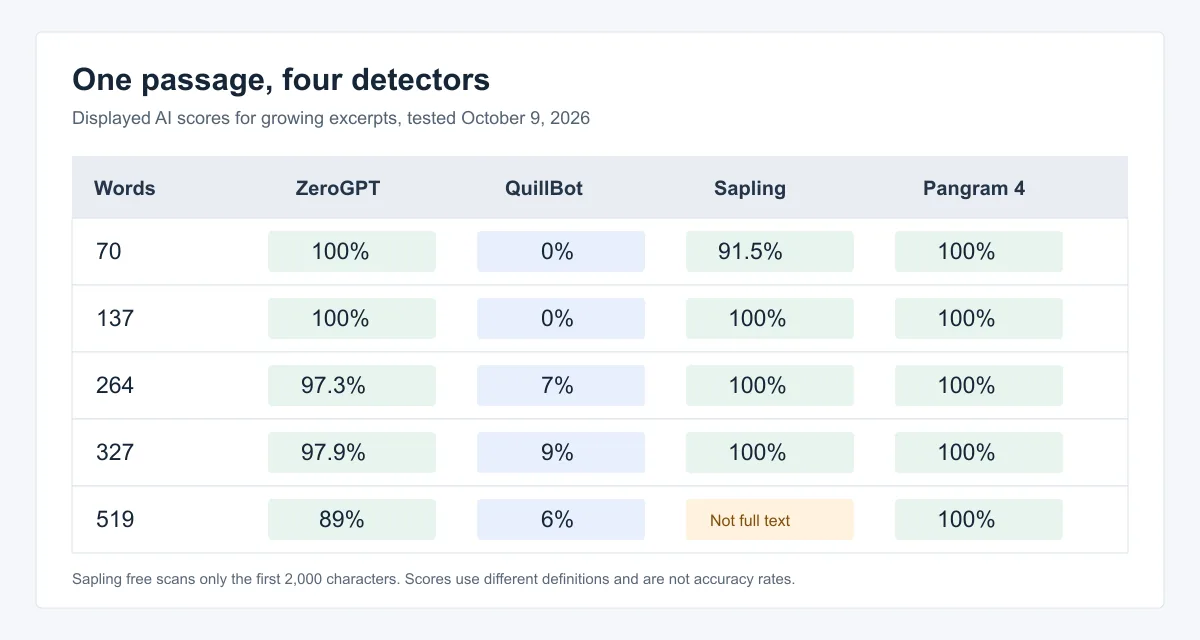
We prepared one 519-word, AI-assisted passage arguing for longer university-library hours. On October 9, 2026, we submitted its first paragraph, then its first two, four, five, and eight paragraphs to the public interfaces of ZeroGPT, QuillBot, Sapling, and Pangram 4. We did not rewrite the earlier paragraphs between scans. Each longer input simply added the next paragraphs. Character counts include spaces and the blank lines between paragraphs. You can read the full source passage below to see exactly what was submitted.
This is a demonstration of how four products respond to one text at different lengths, not a benchmark of detector accuracy. Their percentages are not interchangeable: QuillBot labels its figure the share of text likely AI-generated or AI-refined, Sapling describes its figure as a model probability, and Pangram reports a fraction of the text classified as AI. We did not run this text through Turnitin, GPTZero, Originality.ai, Copyleaks, Winston AI, or Grammarly. Their entries later in this article are published product requirements, not our test results.
| Words (characters) | ZeroGPT | QuillBot | Sapling | Pangram 4 |
|---|---|---|---|---|
| 70 (408) | 100% | 0% | 91.5% | 100% |
| 137 (844) | 100% | 0% | 100% | 100% |
| 264 (1,611) | 97.3% | 7% | 100% | 100% |
| 327 (2,000) | 97.9% | 9% | 100% | 100% |
| 519 (3,177) | 89% | 6% | Not full text | 100% |
One input, four very different readings: at 70 words, ZeroGPT and Pangram displayed 100% AI, Sapling displayed 91.5%, and QuillBot displayed 0%. This does not establish which detector is correct. The source was prepared with AI assistance, but a detector score is not a measured ground-truth percentage of authorship. Pangram also warned that confidence was limited for its 70- and 137-word scans. QuillBot identified its scanning model as v7.1.0; Pangram identified Pangram 4.0. These versions can change.
The scores also did not move steadily with length. ZeroGPT rose slightly from 97.3% at 264 words to 97.9% at 327, while QuillBot moved from 7% to 9% and then down to 6% on the full passage. Pangram stayed at 100%. Extra paragraphs bring extra evidence, but they also bring different vocabulary, sentence patterns, and ideas. This test cannot isolate word count from the content that was added.
The 519-word Sapling cell is intentionally blank. Its free page analyzes only the first 2,000 characters. When we pasted the full 3,177-character passage, the editor retained only the beginning, so any displayed score would describe a truncated excerpt, not the whole text. We did not present that as a full-passage result. Pangram counted the full passage as 520 words in its interface, while our whitespace-based count and QuillBot counted 519; that one-word difference illustrates why product word counts may vary.
ZeroGPT accepted the 70-word excerpt, yet its own FAQ recommends 150 to 200 words or more for optimal results and says 500 to 1,000 or more can improve stability. Acceptance and confidence are different questions. A 100% label on 70 words is still only an automated reading of those 70 words.
Minimum length: ten tools and product routes
These requirements were checked against the companies' own documentation on October 9, 2026. They apply to different products and submission routes. A word minimum should not be converted into a character minimum using a fixed ratio, because word length, language, and whitespace vary. The labels below distinguish an enforced minimum from a recommended length.
- Turnitin AI Writing Report: At least 300 words of qualifying prose in long-form writing, with a maximum of 30,000 words. Merely reaching 300 total words in a file is not enough if much of it is code, a table, or bullet points.
- Pangram 4: Its current model card requires at least 50 words of natural-language prose. That is its input floor, not a guarantee of strong confidence; our 70- and 137-word reports explicitly said confidence was limited by short text.
- GPTZero dashboard: Its published benchmarking method describes a 250-character dashboard minimum, roughly 50 English words. That is a floor for submission, not a promise that 50 words settle authorship.
- Originality.ai: The website requires 100 words, while its API requires 50. Originality.ai says accuracy decreases below 100 words, even where the API accepts the input.
- Copyleaks: Its web platform specifies 255 characters; the browser extension specifies 350 characters. These are character counts, not word counts.
- QuillBot: Its public guidance says at least 80 words, but the editor we used offered scanning from 40 words and accepted our 70-word excerpt. Its help article also mentions both a 40-word interface message and an 80-word tip. We treat 80 as the recommended target, not an enforced minimum in our test.
- Sapling: Its free detector says accuracy improves after roughly 50 words, which is advice, not a hard floor. The free page checks only the first 2,000 characters, an important maximum when comparing long excerpts.
- Winston AI: Its help center specifies a 500-character minimum to run a scan. That is an input rule, not a 500-word recommendation.
- Grammarly AI Detection API: The API documentation sets a 30-word minimum for a score. This is specifically the developer API; it should not be assumed to describe every Grammarly interface.
- ZeroGPT: Its FAQ recommends 150 to 200 or more words, with longer passages preferred for stability. In our test, its public page returned results for all five inputs, including the 70-word one.
Scribbr is another name readers may encounter, but it is not an eleventh independent model in this comparison. Its public page advertises up to 1,200 words per free submission, and the detector embedded on that page identifies QuillBot as its provider. We did not count a second QuillBot-powered interface as separate model evidence.
These numbers answer different questions. Some are enforced product minimums, some are channel-specific limits, some are recommendations for more useful results, and Sapling's 2,000 characters are a free-tier maximum. Treating them as interchangeable leads to bad comparisons. For example, a 264-word essay can be long enough for Pangram to scan but still fall short of Turnitin's AI Writing Report requirement. Our 327-word excerpt cleared Turnitin's word-count threshold, but we did not submit it to Turnitin or verify that its file and prose extraction would qualify.
Why Turnitin's 300 words are not just a word-counter target
Turnitin describes qualifying text as sentences in paragraphs forming a longer piece of writing, such as an essay or article. It warns that its model does not reliably handle poetry, scripts, code, tables, bullet points, or other unconventional short-form text in the same way. If a document has 320 total words but a large share comes from a bibliography or data table, do not assume the AI Writing Report will treat all 320 as eligible prose.
The report also has its own interpretation rules. Turnitin says its AI percentage is separate from its similarity score, and that detection may misidentify both human and AI writing. The company says it should not be the sole basis for adverse action against a student. For AI percentages above zero and below 20%, its current report shows an asterisk rather than an exact percentage because of false-positive concerns. These details matter more than trying to find a magic length that produces a reassuring number. All of these rules come from Turnitin's report guide.
How to use a detector result without overreading it
Scan the actual unit of writing
If you want feedback on an essay, scan the complete essay rather than only its opening. A paragraph can sound more uniform than the finished piece. If you want to examine a particular section, keep the full scan as context and compare the section to it. Do not treat scores from two different detectors as the same measurement: they use different models, scales, input handling, and reporting rules.
Keep a record of what changed
When testing revisions, save the exact text, its word and character counts, the detector name and model version if displayed, the date, and the visible result. Check whether the product analyzed the entire submission or silently truncated it. A changed score might reflect a revision, a longer excerpt, or a model update. If all three change at once, there is no honest way to attribute the difference to one cause. Our tests hold the opening text constant but still add new content at each step; that is why we call this a length demonstration, not controlled proof of a length effect.
Improve the draft for a reader, not a percentage
If a short draft feels generic, the useful fix is usually to add what the writer actually knows: a specific observation, a checked source, a limitation, or a counterexample. Do not pad a paper merely to pass a scanner's minimum. If the prose is stiff, Ryter Pro's text humanizer can help with a first editing pass, but review every change for factual accuracy and voice. A rewrite tool cannot create firsthand experience or guarantee a detector result. In academic work, follow the course's rules on AI assistance and disclose its use where required.
The practical answer to how many words for AI detection is therefore: meet the specific tool's eligibility rule, then prefer a representative stretch of connected prose over an isolated sentence. Even at 500 words, a score is a clue to investigate, not a verdict.
The complete passage used in our test
The following 519 words were written for this demonstration with AI assistance. The test inputs were exact prefixes ending after paragraphs one, two, four, five, and eight. This makes it possible to check the counts and repeat the exercise on the same text.
Read the 519-word source passage
A university library is more than a place to borrow books. For many students, it is the only quiet room they can use for sustained work. When the building closes early, that need does not disappear. It moves into crowded apartments, noisy residence halls, or cafes where buying something may be the price of a seat. Longer opening hours therefore deserve consideration as a question of access to study space.
The argument is strongest during the weeks before exams. Students often have jobs, laboratory sessions, or family responsibilities during normal library hours. A student who works until six may have only a short window to use reference materials or meet a project group. Extending access on selected evenings would give these students a realistic option without requiring the university to keep every service running around the clock.
That said, a longer schedule has costs. Security staff, cleaning crews, and desk workers would need coverage. Keeping the entire building open all night could be expensive, especially if few people use it after midnight. A sensible pilot would begin with one study floor and a limited number of evenings. Entry counts could show whether demand is high enough to justify a larger program.
The university should also ask who benefits from the pilot. Students who live far from campus may leave before the last bus, even if the library stays open. Others may need accessible transport or a safe route home. An extended schedule alone will not solve those problems. Surveys should ask about travel, disability access, and the times people would actually use the space.
Some administrators might argue that digital resources make longer library hours unnecessary. Online databases and electronic books do help, but they do not create a quiet desk or reliable internet connection. A shared room can also make it easier to ask a librarian for help. The physical space matters precisely because students do not all have the same conditions for working at home.
There are smaller changes worth testing before a permanent expansion. The library could open two hours later on weekdays during exam season. It could reserve a room for quiet study and another for group work. The campus might also publish live occupancy information, so students can avoid a trip when every seat is taken. Each option has a measurable cost and a clear use case.
A useful evaluation would track more than visits. It should record the hours when seats fill, whether students return, and what kinds of work bring them in. Staff feedback matters as well. If a pilot leaves workers with unpredictable shifts or inadequate support, its apparent success would hide a different problem. The university should publish the findings before deciding whether to continue.
Longer library hours are worth trying because they address a practical obstacle faced by many students. The case for them is not that every student needs an all-night building. It is that students need enough time and suitable space to work. A limited pilot, reviewed with access and staffing in mind, would provide better evidence than either an immediate permanent expansion or a quick rejection.
FAQ
Can an AI detector check 50 words?
Some can accept that amount. GPTZero's published dashboard minimum is 250 characters, about 50 English words, and Originality.ai's API minimum is 50 words. That does not make a 50-word verdict dependable. Originality.ai specifically warns of reduced accuracy below 100 words.
Does Turnitin scan under 300 words?
Its AI Writing Report requires at least 300 words of qualifying long-form prose. A shorter submission may still go through other Turnitin workflows, but it does not meet this AI report's stated requirement.
Is 300 words enough for reliable AI detection?
Three hundred words meet Turnitin's minimum if the text otherwise qualifies. It is not a universal reliability threshold. The result still depends on the tool, the kind of text, and the writing itself.
Why did the score change when we added text?
Each new paragraph added linguistic evidence and changed the mix of ideas and sentence structures. ZeroGPT moved from 100% on 70 words to 89% on 519, while QuillBot moved from 0% to 6% and Pangram stayed at 100%. These scans cannot tell us which specific added features caused any change.
Is a 100% AI score proof that a passage was entirely AI-written?
No. Each tool defines and calculates its score differently. Pangram labeled our 70-word excerpt 100% AI while warning that confidence was limited by its short length; QuillBot labeled the same excerpt 0% likely AI. A score can support a closer review, but it cannot substitute for drafts, sources, writing-process evidence, or a conversation with the author.
Bottom line
Check the exact product and submission route before you scan. Turnitin needs 300 qualifying prose words; Pangram 4 accepts 50 words; other services may count characters instead. Also check upper limits: Sapling's free page could not assess our whole 519-word passage. For an interpretation worth discussing, submit the actual piece or a substantial connected excerpt, preserve your draft history, and treat the output as one fallible signal. Our four-detector comparison shows that score differences between tools can be much larger than changes caused by adding paragraphs to the same text.