
GEO vs. SEO: optimizing AI-generated content for both is mostly an editing problem, not a prompting trick. A useful page still needs a clear answer, first-hand detail, verifiable evidence, sensible structure, and a technically accessible website. The difference is that the finished page may now be discovered through Google results, AI Overviews, ChatGPT search, Bing Copilot, or another answer engine.
That does not mean one draft should be written for people and a second version for machines. In its current guidance, Google says the same foundational SEO practices remain relevant to its generative AI features. The practical goal is therefore simple: publish one strong page that a reader can understand and a search system can accurately interpret, retrieve, and cite.
SEO and GEO are not rival systems
SEO helps a page become crawlable, understandable, and competitive in search results. Generative engine optimization, often shortened to GEO, pays extra attention to whether an answer system can extract a useful passage and connect it to a reliable source. There is substantial overlap.
Google's official AI features and your website guide says its generative AI experiences are rooted in core Search ranking and quality systems. It does not prescribe a special AI-only writing format. In fact, Google specifically says that site owners do not need new machine-readable files, artificial content chunking, or separate rewrites for AI features.
| Question | SEO focus | GEO focus |
|---|---|---|
| Can the system access the page? | Crawling, indexing, internal links | Access for relevant search crawlers |
| Does the page satisfy the query? | Intent, relevance, depth | Direct answers and quotable evidence |
| Can readers trust it? | Accuracy, authorship, sources | Traceable claims and clear attribution |
| Can performance be measured? | Search Console and analytics | Citations, referral traffic, AI reports |
GEO is useful as a lens, especially when reviewing how clearly a page states its evidence. It becomes unhelpful when it is sold as a secret replacement for SEO.
Why an untouched AI draft often underperforms
AI can produce a clean outline quickly, but a clean outline is not the same as a publishable article. The most common weakness is not bad grammar. It is low information value.
- The claims are broad. Phrases such as "businesses are increasingly adopting AI" say little unless they are tied to a date, dataset, example, or observed result.
- The language is interchangeable. If a paragraph could appear on fifty competing websites without changing a noun, it gives a search system little reason to prefer that source.
- The evidence is invisible. A polished claim without a source, method, screenshot, calculation, or named experience is difficult to verify.
- The draft answers the topic, not the reader. It defines terms but skips cost, limitations, setup details, failure cases, and the decision a person actually needs to make.
- The confidence is too high. AI drafts often turn a conditional observation into a universal rule.
Google's guidance on using generative AI content focuses on accuracy, quality, and relevance. Using AI is not the issue by itself. Publishing many low-value pages primarily to manipulate rankings can violate Google's spam policies.
A practical editing workflow for SEO and GEO
1. Start with the decision behind the query
Before editing, write down what the reader should know or be able to do after reading. "Explain GEO" is a topic. "Help a content editor turn an AI draft into a page that can earn search visibility and citations" is a useful job.
This distinction keeps the article from becoming a glossary. It also suggests the details the page needs: an editing sequence, examples, technical requirements, and a way to measure results.
2. Put the core answer near the top
Do not force readers to cross five introductory paragraphs before reaching the point. State the answer, then qualify it. A direct opening is easier to scan and easier for an answer engine to interpret, but it still needs supporting evidence below.
A good answer block usually contains a conclusion, a boundary, and a reason. For this article, the conclusion is that SEO and GEO share the same foundation. The boundary is that citation visibility varies by platform and query. The reason is that search systems still depend on accessible, relevant, trustworthy source material.
3. Build an evidence list before polishing sentences
Make a small inventory of what only your page can show. Useful evidence can include screenshots, test conditions, product output, customer questions, original data, a worked calculation, or an expert's named observation. Then place each item next to the claim it supports.
External sources should be primary when possible. Link to official documentation for product behavior and to the original study for statistics. Avoid citation chains where one marketing blog cites another marketing blog that cites no underlying source.
4. Replace vague claims with observable detail
Editing for specificity does not mean stuffing every sentence with numbers. It means telling the reader what was observed and under what conditions.
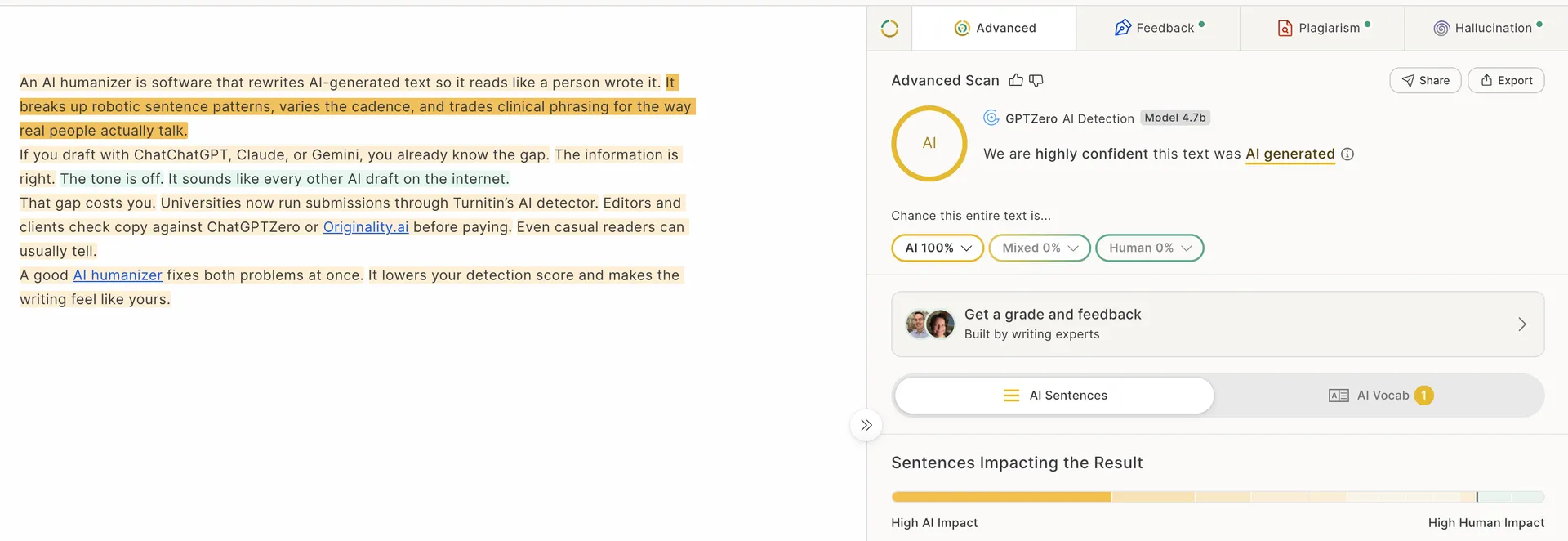
For example, "humanizing the copy improved the result" is weak. A more transparent version is: "In one short sample checked with GPTZero model 4.7b, the displayed result changed from 100% AI to 100% human after rewriting. This was one detector snapshot, not a guarantee for other texts or detectors." The second version is less dramatic and much more useful.
5. Preserve meaning while changing the prose
When an AI draft sounds repetitive, editors sometimes rewrite so aggressively that facts, entities, or qualifications disappear. Keep a list of terms that must survive the edit: product names, dates, measurements, source names, and the exact scope of the claim.
Then improve the prose at paragraph level. Vary sentence length, remove filler, use concrete verbs, and add transitions that reflect the actual logic. Do not merely swap words for synonyms. That often creates awkward language while leaving the original structure untouched.
6. Edit for retrieval without writing in fragments
Clear headings help both readers and systems locate the relevant section. Each section should answer one identifiable question, and its first sentence should make the section's purpose obvious. Lists and tables are useful when the information is genuinely comparative or procedural.
There is no need to reduce the entire page to tiny, context-free blocks. A passage can be concise and still explain its assumptions. Quotable content is usually specific and self-contained, not unnaturally chopped up.
A candid AI draft test with Ryter Pro
To make the workflow concrete, we tested a short passage about AI humanizers. This is a deliberately small demonstration. It shows what happened to one piece of text in one detector at one point in time. It does not prove that a tool will produce the same score for every topic, length, language, or detection model.
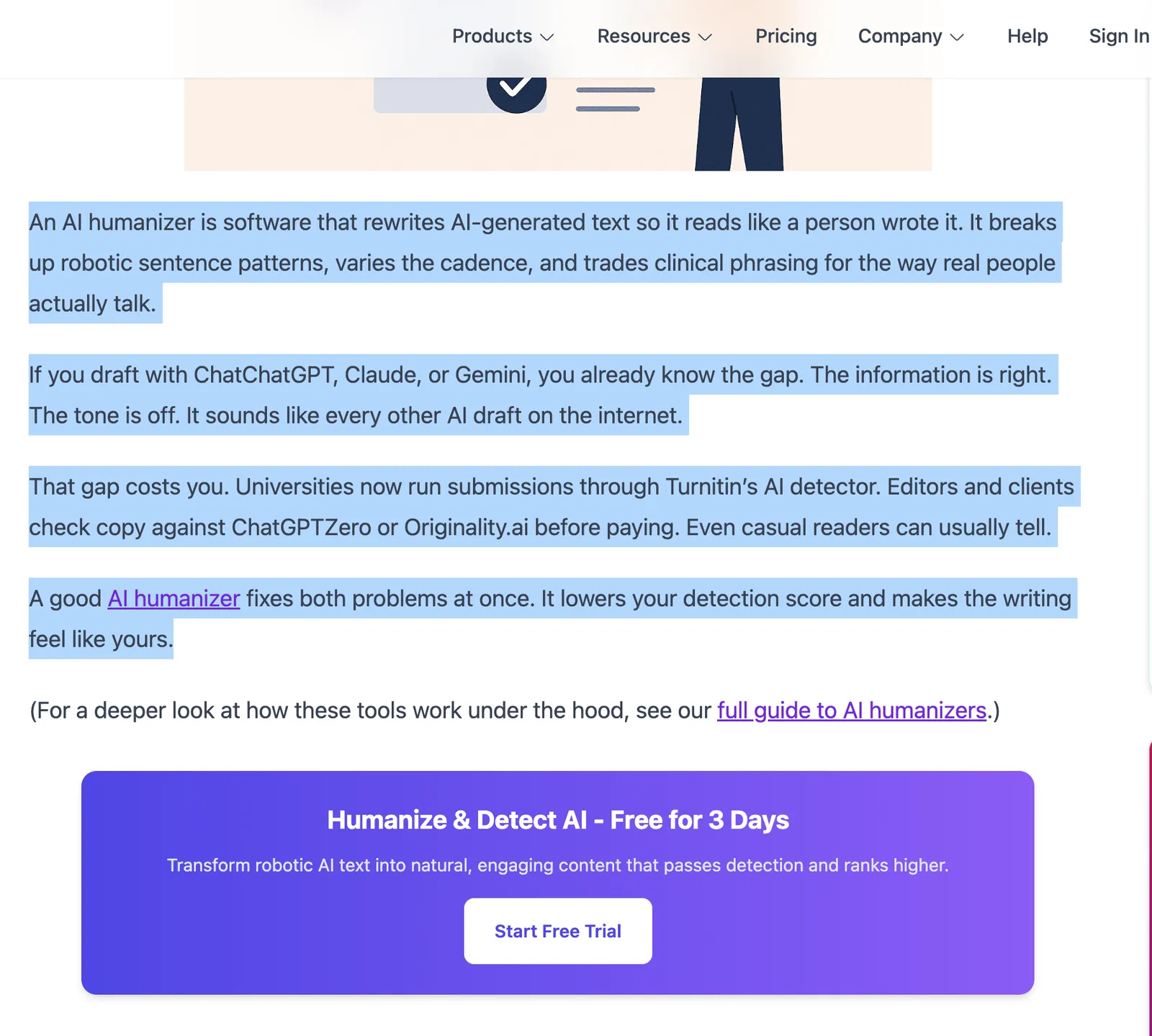
The passage reads smoothly at first glance, but several details need editorial attention. "ChatChatGPT" is an obvious typo. The claim that universities run submissions through Turnitin is too broad without specifying an institution or policy. The sentence about editors checking copy before paying also presents a sweeping behavior as fact. These are quality problems regardless of any detector score.
We then processed the same passage with the Ryter Pro AI Humanizer using its Advanced mode.
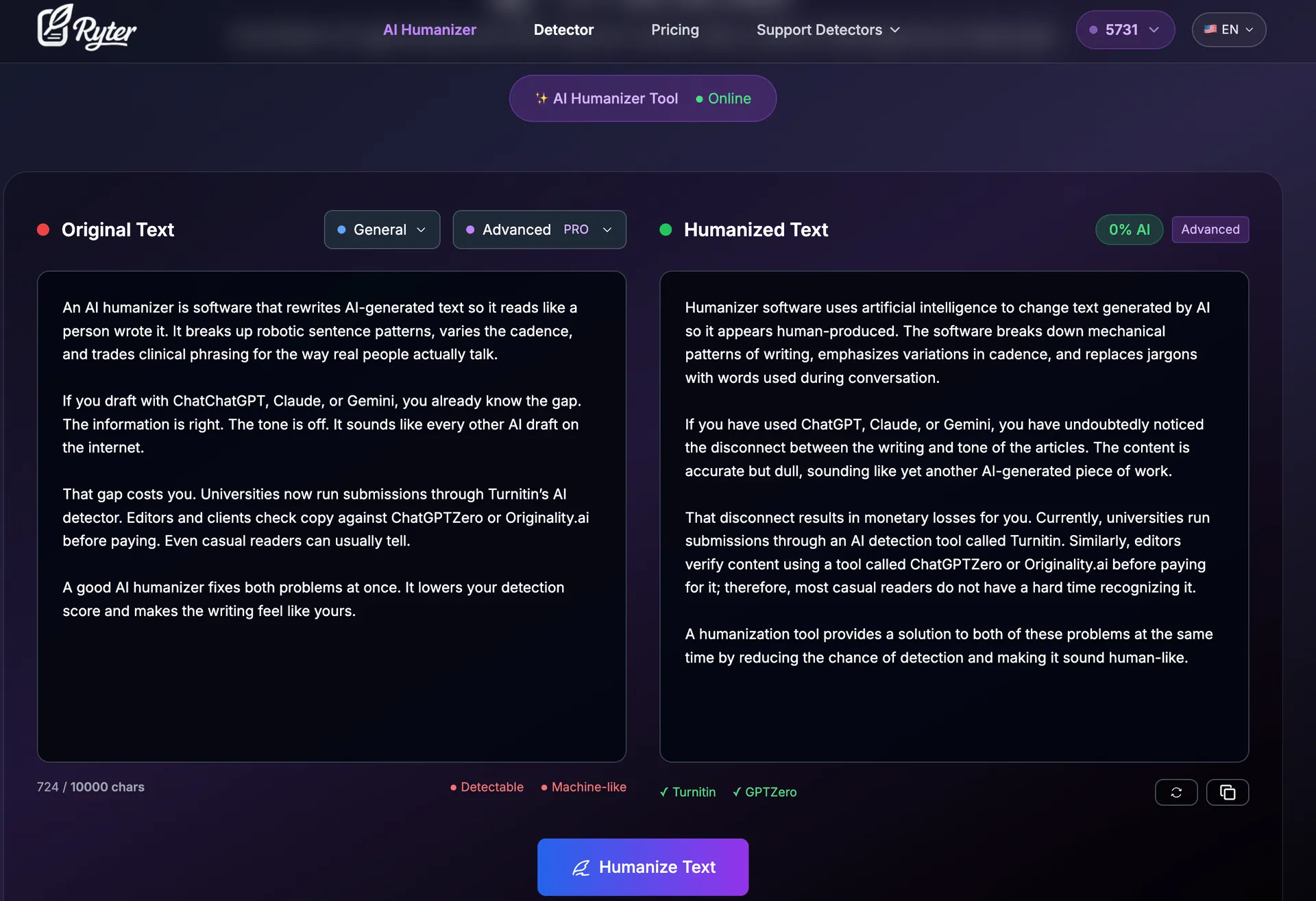
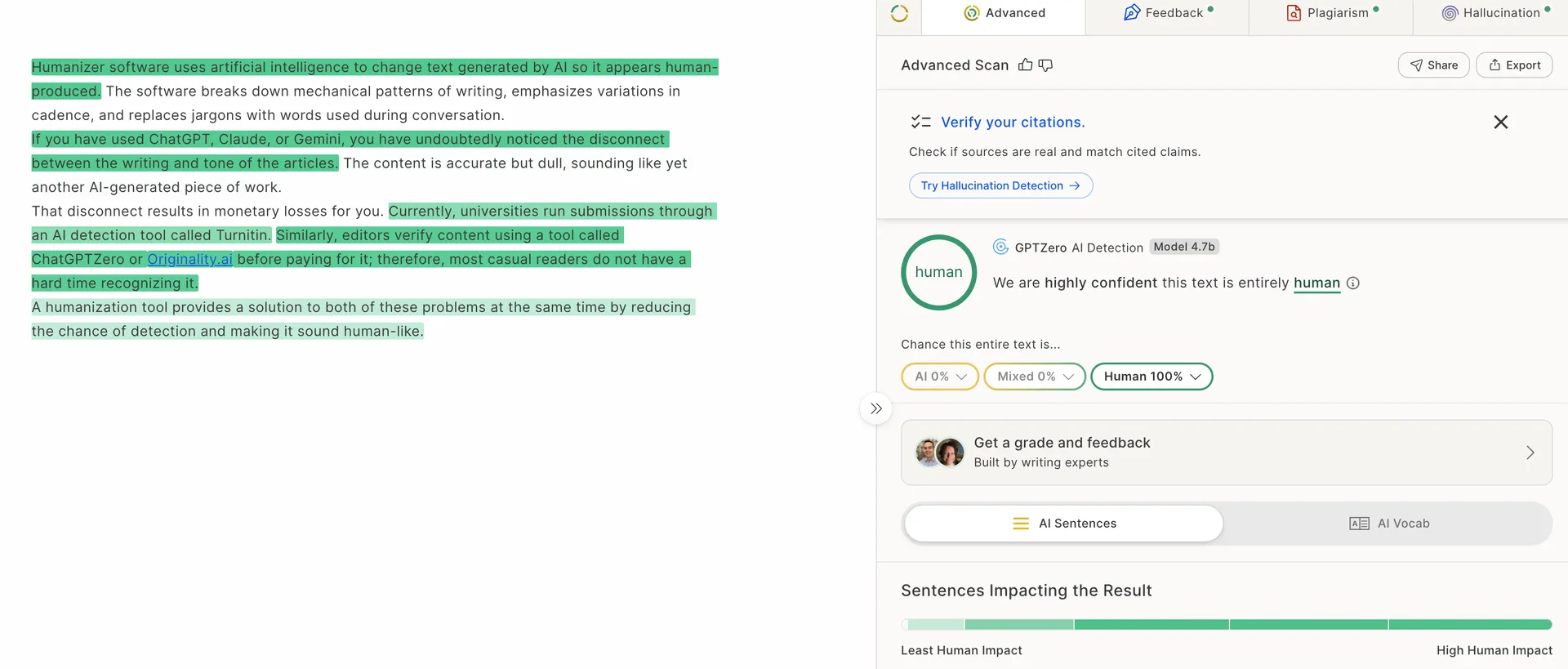
The numerical change is clear, but the responsible conclusion is narrower than "the text is now finished." The rewrite includes phrases such as "monetary losses" and "a tool called Turnitin," which sound more formal than necessary. It also preserves claims that still need evidence. An editor should tighten those sentences, correct factual scope, add a source where appropriate, and run a final readability check.
This case illustrates an important separation: a detector result and editorial quality are different measurements. A humanizer can provide a useful second draft and alter detectable patterns. It cannot decide whether a claim is accurate, whether the example is fair, or whether the article deserves to rank. That responsibility remains with the publisher.
Technical checks that still matter
Strong writing cannot compensate for a page that search systems cannot access. Before publishing, check the following:
- The page returns a successful status code and is not blocked by robots.txt or a noindex directive.
- The canonical URL points to the intended version of the page.
- Important content appears in the rendered HTML and does not depend on a broken client-side request.
- Internal links connect the page to relevant guides, product pages, and category pages.
- Images have descriptive alt text, useful captions, compressed file sizes, and stable dimensions.
- Structured data matches the visible page. Google's structured data documentation is the right reference for supported markup and eligibility.
Structured data can help Google understand entities and qualify pages for certain rich results, but it is not a special requirement for appearing in Google's AI features.
Access for ChatGPT and other AI search products
Different platforms use different crawlers and controls. OpenAI's publisher and developer FAQ says public websites can appear in ChatGPT search and identifies OAI-SearchBot as the crawler used for search visibility. GPTBot is a separate control related to possible model training. A site can therefore make an explicit choice about search access and training access rather than treating them as the same setting.
OpenAI also notes that ChatGPT referral URLs include utm_source=chatgpt.com, which makes some referral visits identifiable in analytics. As with any crawler policy, verify the current official documentation before changing robots.txt.
Bing added an AI Performance report in Bing Webmaster Tools. Its public preview includes citation counts, grounding queries, cited pages, and citation activity. These reports are more useful than trying to infer AI visibility from rank tracking alone.
How to measure whether the work helped
Do not judge the page on a single metric. Review a small group of signals over a meaningful period:
- Search visibility: impressions, clicks, average position, and the queries associated with the page.
- AI visibility: citation reports where available, manual checks of representative prompts, and referral sessions from answer platforms.
- Reader behavior: engaged sessions, scroll depth, conversions, and whether visitors continue to another relevant page.
- Content maintenance: broken sources, outdated dates, changed product behavior, and claims that need revision.
Manual prompt checks should use a fixed query set and record the date, platform, location, and account state where possible. AI answers change. A screenshot is evidence of one observation, not a permanent ranking.
A final editing checklist
- Does the introduction answer the actual query without a long preamble?
- Does every major claim have a source, example, method, or clear qualification?
- Did you add information that was not already present in the AI draft?
- Are named tools, organizations, dates, and statistics accurate?
- Can each heading stand as a real reader question or task?
- Are tables readable on mobile and limited to useful comparisons?
- Have you removed repetitive summaries and generic promotional language?
- Did a person review the final version for tone, logic, and factual scope?
- Can search crawlers access the canonical page and its important content?
- Do your analytics and webmaster tools capture both search and AI referrals where available?
Frequently asked questions
Is GEO different from SEO?
GEO emphasizes visibility and citations in generative answer systems, while SEO covers the broader work of earning visibility in search. In practice, they share core requirements: accessible pages, useful answers, trustworthy evidence, and clear structure. GEO is best treated as an additional measurement and editing lens, not a replacement for SEO.
Does Google penalize AI-generated content?
Google's published guidance focuses on content quality and purpose rather than banning a production method. AI-assisted content can be useful, but scaled pages created mainly to manipulate rankings may violate spam policies. Human review, factual accuracy, and original value remain essential.
Will humanizing AI text improve rankings?
Not by itself. A rewrite may improve rhythm, readability, and originality, but rankings depend on relevance, quality, competition, authority, technical accessibility, and many other factors. Treat humanization as one editing step, then verify facts and add evidence that the original draft lacked.
Do I need an llms.txt file for Google AI features?
Google's current guidance says no new machine-readable files are required for its AI features. Standard crawlability, indexability, content quality, and supported controls remain the foundation. Other services may publish their own crawler documentation, so check each platform separately.
Can an AI detector prove who wrote a passage?
No detector score should be treated as proof of authorship. Scores can vary across tools, versions, text lengths, and edits. Use them as one signal, document the test conditions, and avoid making disciplinary or publishing decisions from a single automated result.
Conclusion
The most durable way to optimize AI content for SEO and GEO is to make the page worth retrieving. Begin with a direct answer, add evidence the model could not invent from your experience, qualify claims, and keep the page technically accessible. Use rewriting tools to improve a draft, but do not confuse a smoother sentence or lower detector score with a finished article.
Search and answer systems will continue to change. Specific, sourced, maintained content gives you something more stable to work with than any short-lived formatting trick.