
If you searched for how to bypass gptzero, you may be looking for a quick rewrite that changes an AI score. That is understandable, but it is also the wrong place to start. GPTZero is no longer a simple checker that can be handled by swapping a few words or adding random typos. Its current system looks at the whole document, the relationships between tokens, and patterns learned from many types of human and AI writing.
A more useful goal is to make AI-assisted writing accurate, specific, and genuinely edited by the person who will publish it. That process can reduce the chance of an AI-like classification, but no responsible tool can promise a permanent result across every detector, model version, document type, or policy.
This guide explains what GPTZero publicly says about its current detection approach, what usually fails, and how to use a human editing workflow with Ryter Pro as a second editing pass.
What does "how to bypass gptzero" really mean?
People use the phrase in different ways. Some want to reduce a false positive on writing they created themselves. Others have an AI-generated draft that sounds generic and want to make it clearer and more personal. A third group wants to hide unapproved AI use in an academic or professional setting.
Those situations are not the same. If your school, employer, client, or publisher requires disclosure or prohibits generated text, rewriting the document to hide its origin does not solve the policy problem. Keep your notes, drafts, sources, and revision history. Use AI tools only within the rules that apply to the work.
For legitimate editing, "bypass" should mean improving the text so that it reflects the writer's own reasoning instead of relying on surface tricks.
How GPTZero's current detector works
Older articles often explain AI detection mainly through perplexity and burstiness. Those concepts are useful for understanding why generated prose can feel predictable, but GPTZero's own support documentation says it stopped using perplexity and burstiness as the core of its AI detection after moving to a deep-learning architecture in 2023.
GPTZero's current public explanation describes a broader process:
- The text is split into tokens, which are small pieces of words and punctuation.
- The model converts the document into a numerical representation of its writing style.
- Similar documents form overlapping patterns in a learned feature space.
- A classification boundary estimates whether the text is human, AI, or mixed.
This is a simplified explanation, not a list of every internal feature. The detector is trained on human and AI samples from different domains, including essays, academic writing, news, blogs, social posts, legal writing, and creative work.
GPTZero's 2026 technical report describes a hierarchical, multi-task architecture. It supports more detailed categories than a simple human or AI label, including mixed writing, AI-polished text, and paraphrased AI text. The report also describes automated red-teaming designed to test the model against paraphrasing and other attempts to alter generated text.
That matters for anyone searching for how to bypass gptzero. A paraphraser may change the vocabulary while leaving the larger writing pattern intact. GPTZero's current approach is designed to look beyond individual words.
Why the score is not a final verdict
GPTZero's percentage is a probability produced by a classifier. It is not a chemical test that reveals the history of every sentence. GPTZero's own support material says that AI detection is probabilistic and should not be used as the only proof for academic punishment or discipline.
The Advanced Scan can highlight sentences that have a disproportionate effect on the result. However, GPTZero also explains that the document is analyzed holistically. Changing one highlighted sentence may not change the overall classification if the same pattern appears throughout the passage.
This is why a human-written essay can receive an AI score, especially when it uses formal language, follows a predictable structure, or contains short and highly polished paragraphs. A score should lead to review and conversation, not an automatic accusation.
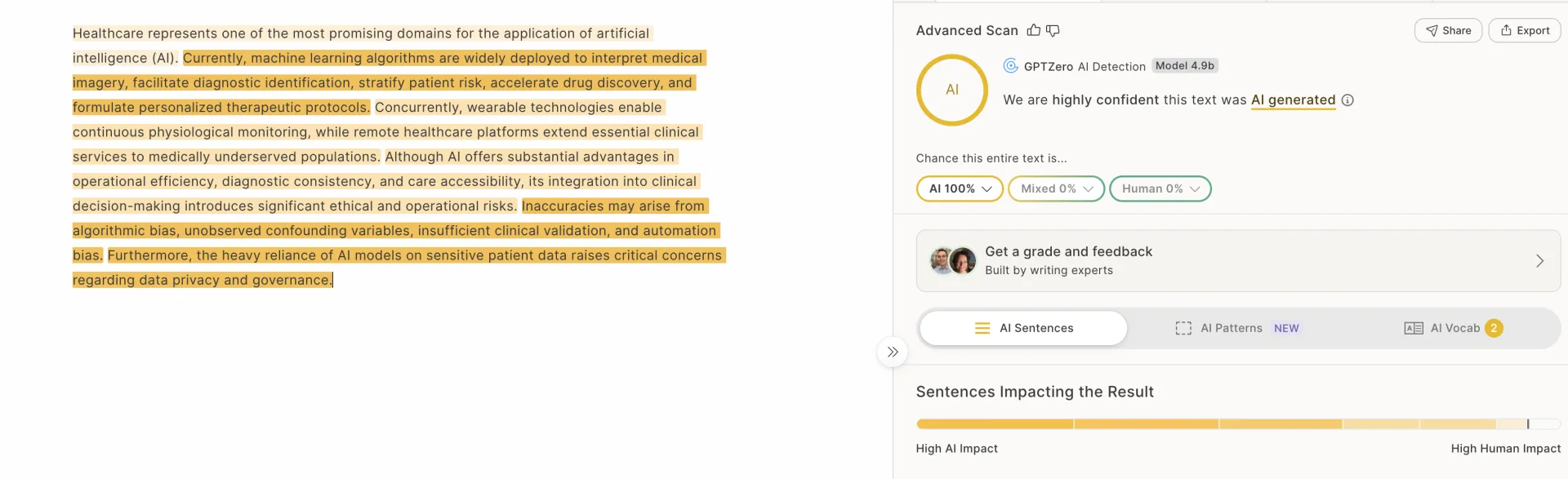
What usually fails when people try to bypass GPTZero
Changing a few synonyms
Replacing "important" with "significant" or "use" with "utilize" does not change the argument, rhythm, or paragraph structure. It can make the writing less natural while preserving the pattern that caused the concern.
Adding mistakes on purpose
Random spelling errors are not evidence of authorship. They lower trust and can create accessibility problems. Real human writing contains decisions, examples, qualifications, and a sense of audience. It does not need a quota of typos.
Adding slang to formal writing
Slang only sounds natural when it fits the writer and the reader. Borrowed slang inserted into a report or essay often makes the passage look more artificial. Describe the relationship with the audience instead of forcing casual words into every paragraph.
Rewriting only the highlighted sentences
Sentence-level feedback is useful, but GPTZero's own explanation says that its document prediction is holistic. If the same structure appears across the whole piece, editing one sentence may not be enough. Read the full passage and look for repeated transitions, generic claims, and paragraphs with no concrete evidence.
A responsible workflow for improving AI-assisted writing
1. Start with material you understand
Before you rewrite, collect the source links, notes, numbers, examples, and decisions behind the draft. Mark the claims you know firsthand and the claims that came from an outside source. A humanizer cannot repair missing research.
2. Add your own point of view
Ask what you agree with, what you would qualify, and what did not work as expected. A paragraph becomes more distinctive when the writer has made a choice or noticed a limitation. Specificity is more useful than manufactured irregularity.
3. Change structure where structure is the problem
If every paragraph follows the same pattern, do not limit the edit to synonyms. Move the answer closer to the question. Combine repetitive points. Add the example before the general explanation. Remove a conclusion that merely repeats the introduction.
4. Read the result as the intended reader
Check whether the tone fits the audience. Confirm every name, date, statistic, link, and technical term. Read the text aloud. Awkward paraphrases are easier to hear than to notice when scanning a screen.
Where Ryter Pro fits
Ryter Pro is most useful after the facts and argument are settled. It can provide a second language-level edit for text that feels repetitive, stiff, or too uniform. The goal is not to insert fake personality. It is to improve sentence structure, pacing, and wording while keeping the writer's meaning available for review.
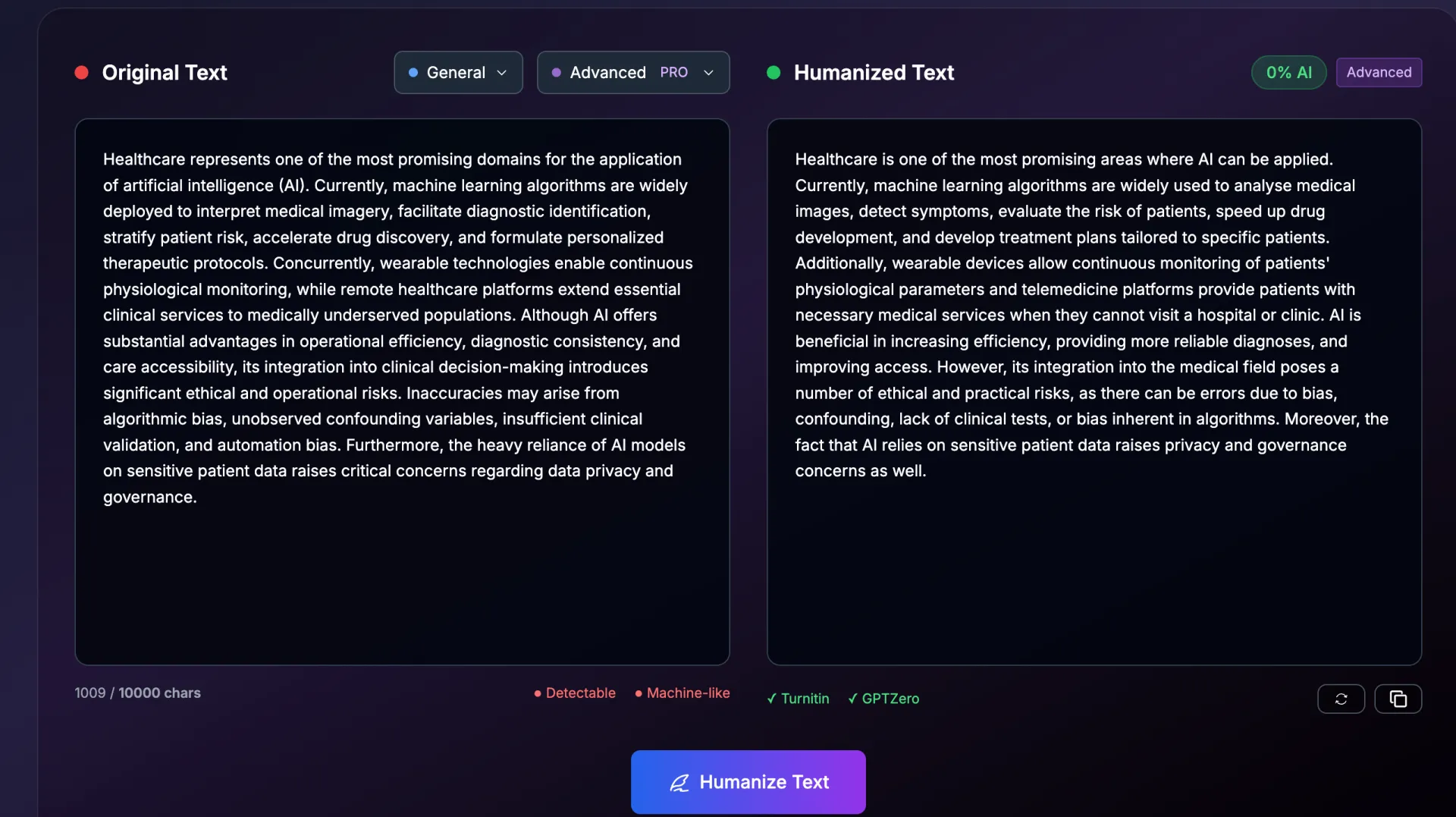
In the test shown above, the original healthcare passage was processed in Ryter Pro's Advanced mode. The rewritten passage changed the sentence structure and phrasing rather than only replacing individual words.
The next step was to scan the revised version in GPTZero again. In this single test, GPTZero Model 4.9b showed 1 percent AI and 99 percent human.
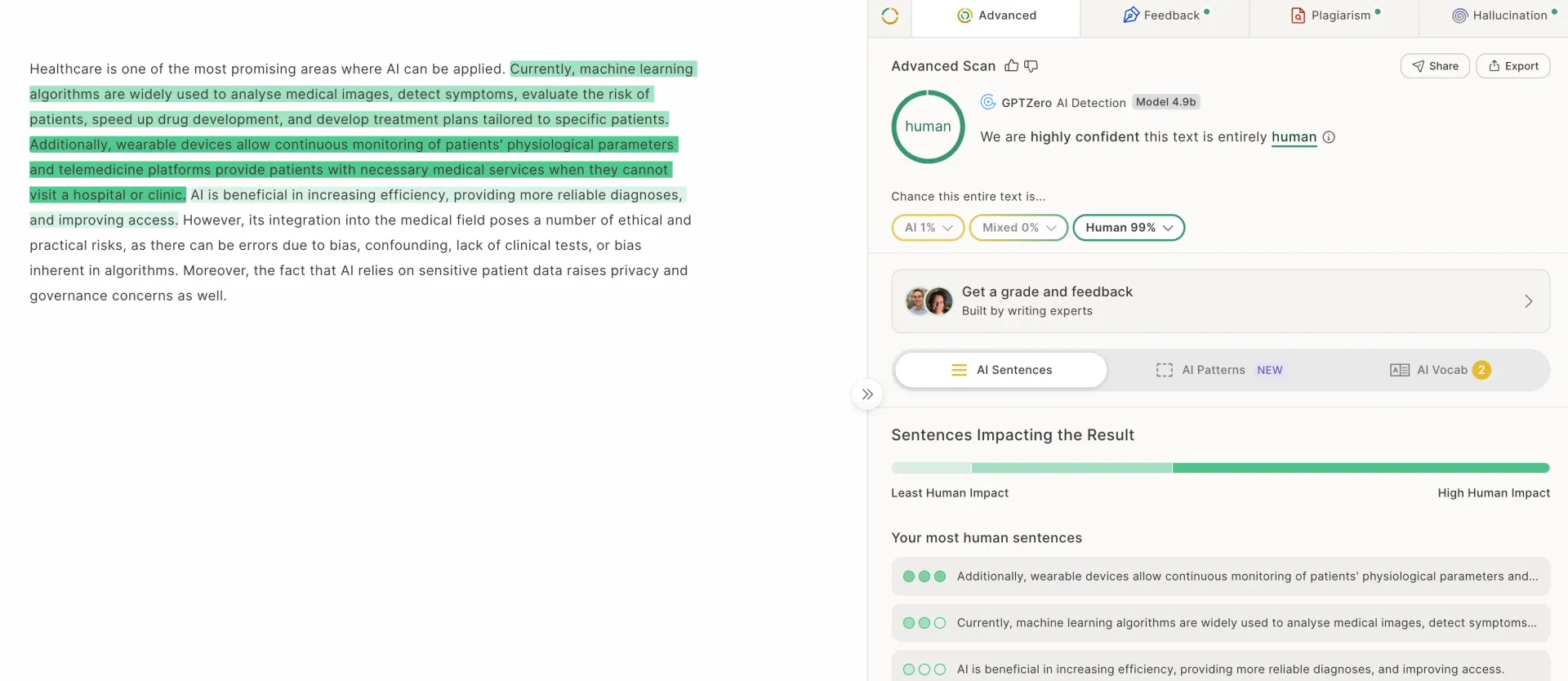
This is useful evidence for the editing workflow, but it is still one test. Results can change with text length, subject, model version, detector updates, and the amount of human revision. It should not be presented as a guaranteed way to bypass GPTZero.
To try the editing workflow, use the Ryter Pro text humanizer, then compare the original and revised drafts yourself. Restore any fact or qualification that became weaker.
How to test your result fairly
- Save the original draft and the revised draft separately.
- Record the detector name, model version, date, text length, and settings.
- Use the same passage when comparing before and after.
- Check the full document, not only the highlighted sentences.
- Read the final version and verify every factual claim.
- Follow the AI policy for the assignment, client, or publication.
Testing several detectors can show that classifiers disagree. That does not mean one score proves the text is human. It means automated attribution has limits.
Frequently asked questions
Can anyone guarantee a way to bypass GPTZero?
No. GPTZero updates its models and tests against paraphrased and AI-polished writing. A result from one document does not predict every future scan.
Does changing vocabulary lower an AI score?
It may change a few sentences, but word swaps alone usually leave the document's structure and meaning unchanged. They can also make the writing worse.
Should I add typos to make writing look human?
No. Add your own reasoning, evidence, examples, and limitations instead. Those changes improve the writing rather than damaging it.
Can Ryter Pro help with a GPTZero result?
Ryter Pro can provide a natural rewriting pass for stiff or repetitive AI-assisted text. Review the output carefully and use it only where your policy allows AI-assisted editing.
Summary
The practical answer to how to bypass gptzero is not a list of tricks. GPTZero now uses a deep-learning system that looks at document-level patterns and can distinguish several kinds of mixed or AI-polished writing. The strongest workflow is to add real research and personal judgment first, then use Ryter Pro for a controlled language edit and verify the final document yourself.
Better writing is the goal. A detector score is only one imperfect signal along the way.