
If you are searching for how to beat Pangram AI detector, the first thing to know is that a quick synonym swap is unlikely to be enough. Pangram feels stricter than many popular AI checkers because it is designed to inspect writing patterns, edited AI text, and mixed human and AI authorship. My own tests support that impression, although they also need to be read carefully: both Pangram results shown here came from short samples, and the interface itself labels short-text confidence as limited.
The more useful goal is not to make a document look random. It is to turn a generic AI draft into writing that contains your own observations, decisions, examples, and wording. Ryter Pro can help with the rewriting stage, but the strongest improvement usually happens when you add human material before you run a humanizer.
What Pangram AI detector is checking
Pangram describes its detector as a classifier that separates likely human and AI writing by learning subtle signals in text. Its public research page says the training process includes hard negative mining, where difficult examples are added back into training, and synthetic mirror prompts that keep human and AI examples close in subject and style.
Pangram has now released Pangram 4. In its technical report, Pangram reports improvements on AI-assisted writing, fine-grained edits, and adversarial or humanizer attacks. That helps explain why a shallow paraphraser can fail even when a paragraph looks different to a person.
This is also why the phrase "beat Pangram" needs some restraint. A detector score is a model output, not proof of authorship. Pangram's own educator guidance calls detection a decision-support tool rather than a disciplinary weapon. The Pangram research overview is worth reading if you want to understand what the company claims about its training approach.
Test one: the original passage scored 100% AI
The first sample was a short paragraph about artificial intelligence in healthcare. It was 117 words long. The writing was grammatically clean, but it had the familiar pattern of an AI-generated overview: a broad opening, a chain of applications, and a final list of risks that sounded balanced without showing a specific source or experience.
Pangram 4 classified the entire passage as AI generated and displayed a 100% result.
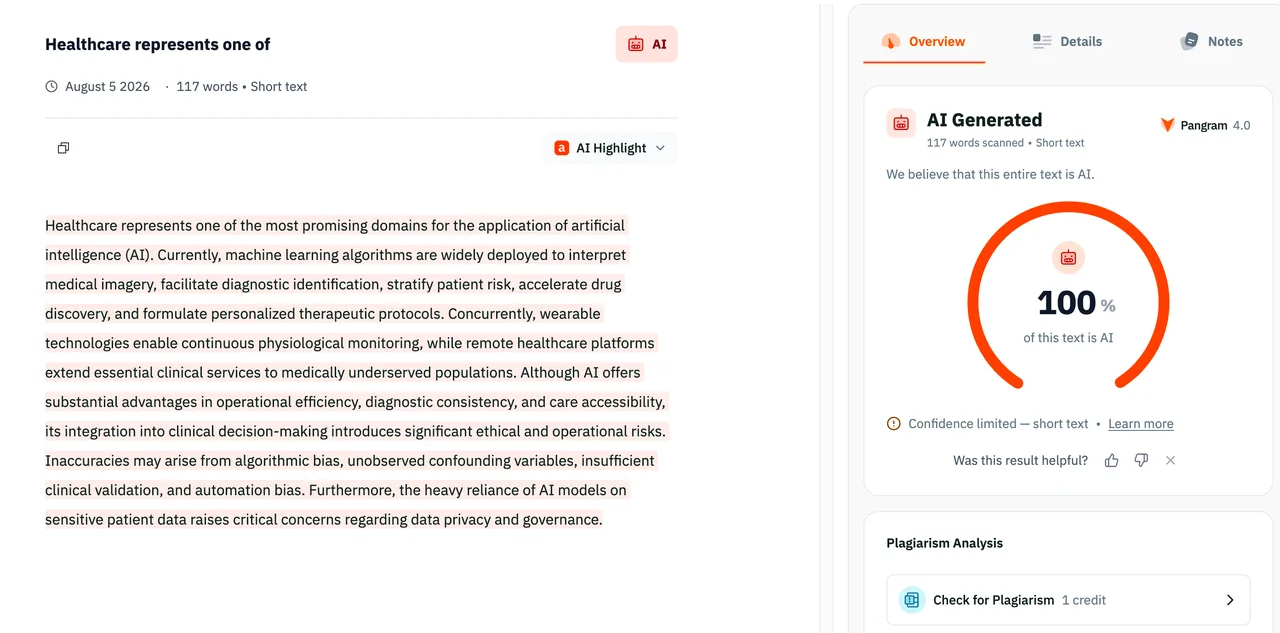
The result was not surprising. The paragraph used formal phrases such as "substantial advantages in operational efficiency" and packed several healthcare claims into a small space. A detector cannot verify the claims from the paragraph alone, but the prose gives it few signs of an individual writer's experience or judgment.
Test two: an aggressive Ryter Pro rewrite
Next, I put the same source into the Ryter Pro AI Humanizer and selected the Aggressive mode. The output changed the sentence structure, phrasing, and length. The Ryter screen shows the original at 1,009 characters and a new version that expands the explanation to roughly 196 words.
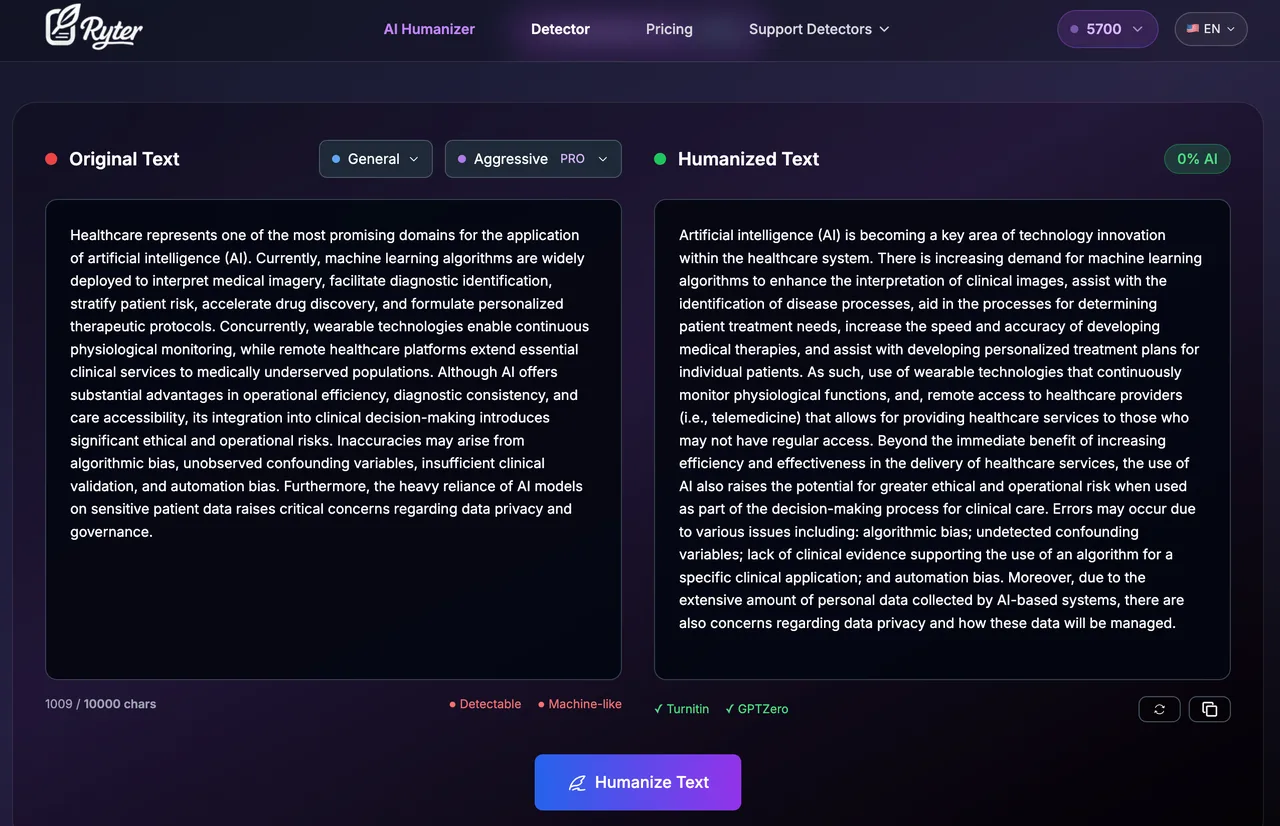
This is more than replacing "currently" with "at present." The rewrite reorganizes the list of healthcare uses and risks. It also adds wording that is not present in the original. That can help change the statistical pattern, but it creates a responsibility for the editor: every added or altered claim still needs to be checked.
I then submitted the rewritten version to Pangram. The second screenshot shows 196 words and a 100% human-written result.
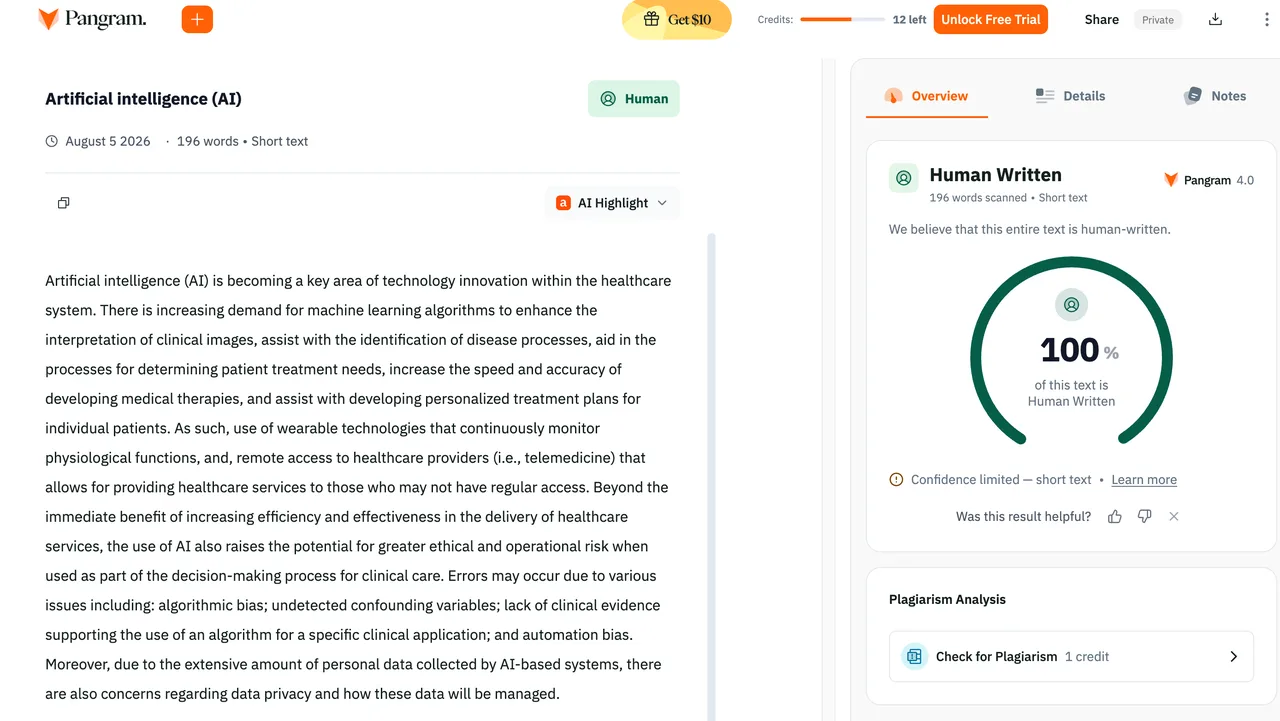
That is a meaningful result for this sample. It is not evidence that every Ryter Pro output will pass Pangram, and it is not evidence that the rewritten paragraph is automatically ready to publish. The text is longer, the wording is different, and the test conditions are not identical to the original 117-word scan.
A second pass with Basic mode
To see whether the result depended only on an aggressive rewrite, I ran another version through Ryter Pro's Basic mode. The original and output are shown side by side below. The mode makes a lighter change to the structure while still revising the phrasing.
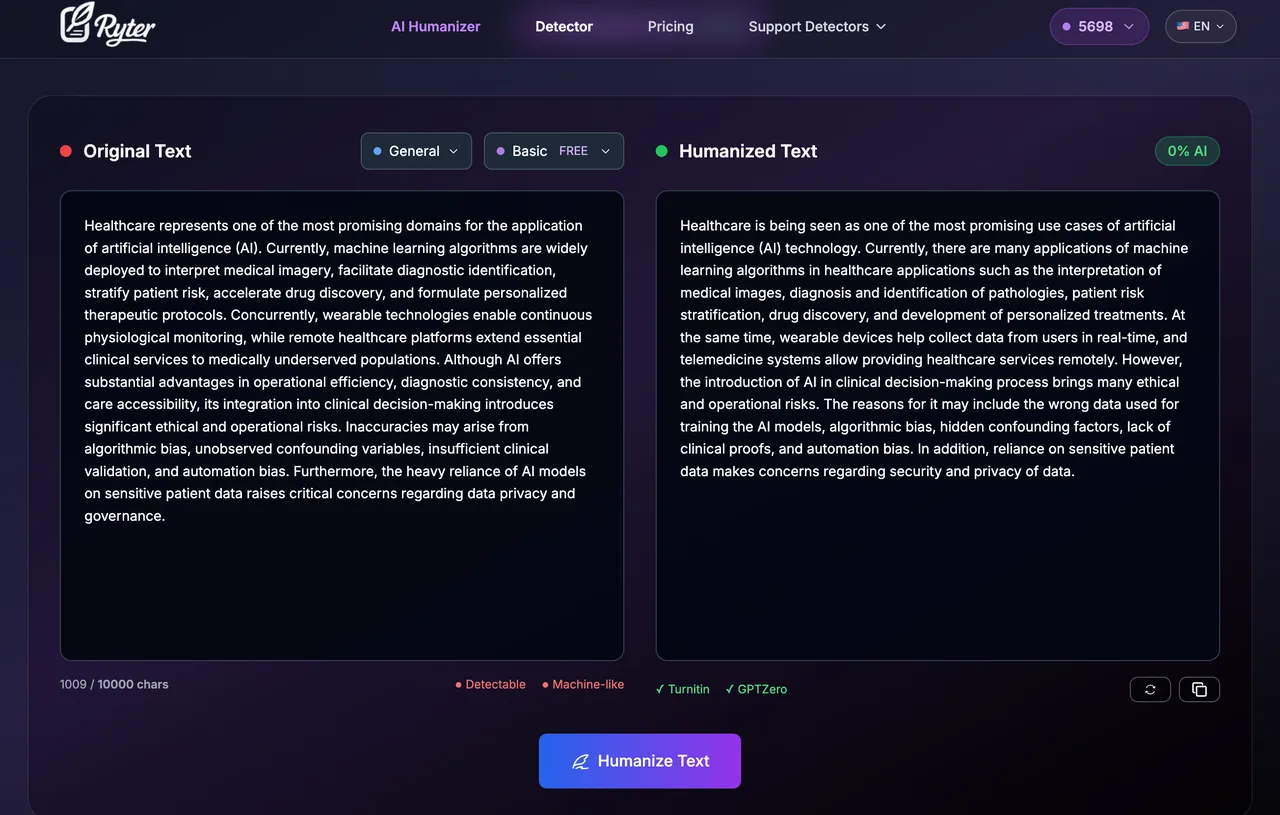
The Pangram result for this version displayed 129 words and labeled the text 100% human written.
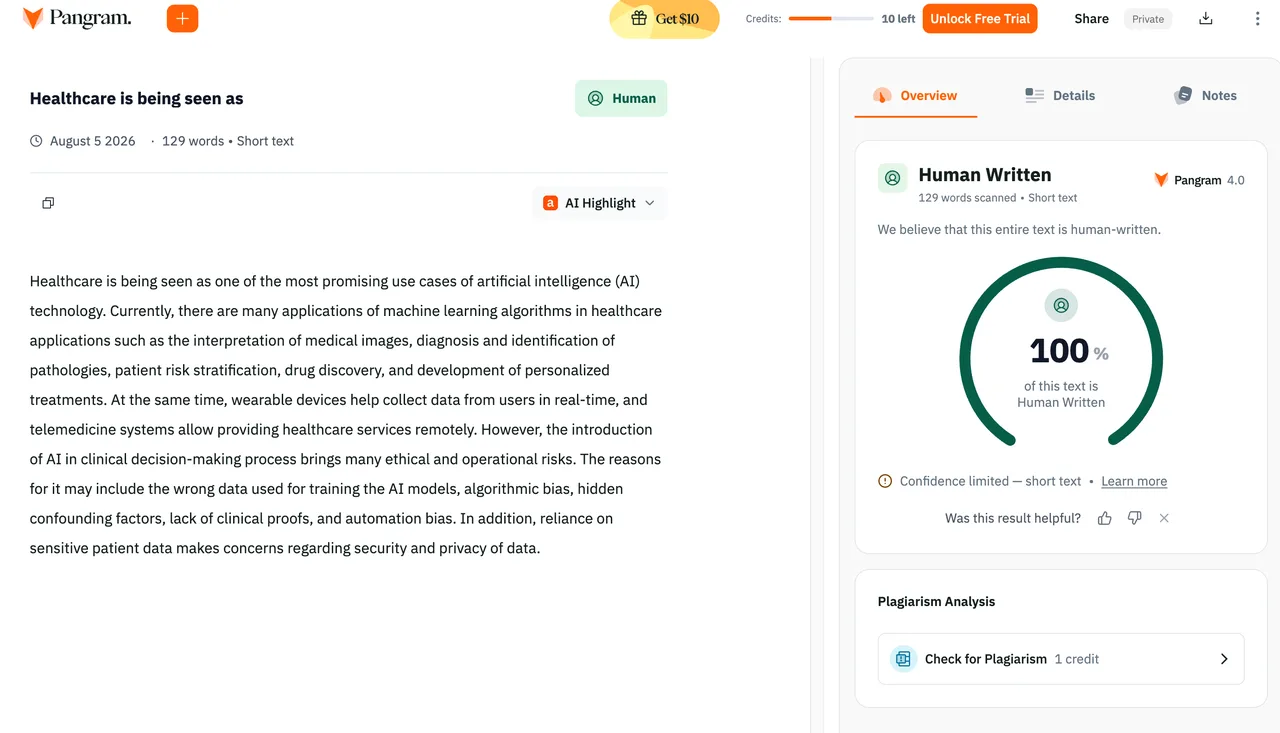
The two results suggest that a rewrite can change how Pangram classifies a short sample. They do not tell us which mode is best for every document. Aggressive mode makes a larger intervention and may require more fact checking. Basic mode may preserve more of the source voice, but it can also leave more of the original structure behind.
Why most humanizers struggle with Pangram
Many humanizers focus on surface variation. They swap words, add contractions, and move a clause from one sentence to the next. That can fool a casual reader into seeing a new paragraph, but it may leave the same underlying organization and cadence.
Pangram's published material says its current model is trained to handle AI editing and humanizer attacks. Its technical report also describes a model that looks at mixed authorship and fine-grained edits. Whether or not every claim in a detector's marketing material holds across every domain, the practical lesson is clear: Pangram is a harder target for shallow paraphrasing than many consumer detectors.
My own experience is similar. Most tools I tried did little to the displayed Pangram score. Ryter Pro was able to lower the signal in these tests, but the best results came when the rewrite changed the structure and I treated the output as an editable draft. The tool was not doing the full job by itself.
A more reliable way to improve a Pangram result
1. Add your own material first
Before using a humanizer, add a detail that belongs to you. Explain what you observed, which option you rejected, what happened during a test, or why a claim matters in your situation. A general statement about healthcare AI is easy to generate. A description of the exact source passage, its word count, and the reason you chose it is harder to imitate because it comes from the actual workflow.
2. Remove claims you cannot support
AI drafts often make broad statements about universities, businesses, or users. Narrow those claims or add a source. This improves the article for readers and prevents a humanizer from polishing an unsupported sentence into something that sounds more authoritative than it is.
3. Choose the rewrite depth deliberately
Use a lighter mode when preserving terminology and structure matters. Use a deeper mode when the draft is repetitive or mechanically organized. Do not choose Aggressive mode simply because a detector score is high. In technical, academic, or medical content, meaning and accuracy come before a cleaner percentage.
4. Read the output as the author
Check names, numbers, qualifications, and technical terms. Then read the passage aloud. If you would never use a phrase such as "monetary losses" in your own writing, change it. Pangram can classify the new sentence as human while a reader still notices that it does not sound like you.
5. Test a representative passage
Do not pad a short sample just to obtain a different score. Pangram's own interface warns that short-text confidence is limited. If you need to check a real document, test a representative section or the full document according to the rules of the platform that will review it. Keep the date, word count, mode, detector version, and result with your notes.
What a 100% human Pangram result does not prove
A 100% human label is not a certificate of authorship. The Atlantic's reporting on Pangram describes the detector as useful but warns that it can make mistakes and should not be the final arbiter. Pangram's own educator page makes a similar point by recommending that detection support a conversation rather than serve as the sole basis for an academic penalty.
There is a second limitation in these particular screenshots: they show short text. The first scan contains 117 words, the Aggressive result contains 196, and the Basic result contains 129. Pangram marks the confidence as limited for short text. That matters because short samples give a classifier less context and make word count changes part of the comparison.
Use the result as feedback about this sample. Do not use it to claim that a humanizer can guarantee a pass, establish who wrote a document, or override a school's, client's, or publisher's AI policy. If a document matters, keep your drafts, sources, notes, and revision history.
Frequently asked questions
Can Pangram detect AI humanizers?
Pangram says it trains against paraphrasing and rewriting tools, and its Pangram 4 report discusses robustness to humanizer attacks. That does not mean every rewrite will be detected or missed. Results depend on the model, text, length, language, and editing process.
Why did Ryter Pro change the Pangram result?
The most likely explanation is that the rewrite changed several signals at once: sentence structure, phrase choice, paragraph movement, and in one test the total length. The screenshots show an observed classification change, not the internal reason Pangram assigned the label.
Should I use Basic or Aggressive mode?
Start with the least disruptive mode that improves the draft. Use Aggressive mode when the original is repetitive and you are prepared to fact check a larger rewrite. Use Basic mode when preserving the source structure matters more. Neither mode is a universal solution.
Is a 100% human score proof that text is human written?
No. It means Pangram classified that submitted sample as human written. Detector scores can be wrong, and a short sample has limited context. Treat the score as one signal alongside authorship evidence, revision history, sources, and the rules that apply to the document.
Conclusion
The practical answer to how to beat Pangram AI detector is to stop treating the task as a word replacement exercise. Add your own experience, narrow unsupported claims, choose the rewrite depth carefully, and review every sentence after Ryter Pro changes it.
In my two short tests, Pangram moved from 100% AI on the original passage to 100% human on both the Aggressive and Basic Ryter Pro rewrites. That is useful evidence of what the workflow can do under these conditions. It is not a guarantee. The strongest final text is still the version that contains real thought, accurate sources, and a voice you can defend.