
Claude watermarking has become a practical concern for anyone who uses Claude to draft articles, documentation, code comments, reports, or study notes. Anthropic now describes two different machine-readable marks: an imperceptible watermark woven into supported Claude-generated text, and signed provenance metadata attached to supported files. These are related, but they are not the same thing.
That distinction changes how you should think about Claude watermark removal. Copying text into a plain editor may affect formatting or file metadata, but it does not automatically prove that a model-level text signal is gone. A genuine rewrite changes the language itself, which is why a tool such as Ryter Pro can be useful as part of a careful editing workflow. It should not be treated as a guarantee that text is human-authored or invisible to every future detector.
What Anthropic says Claude marks
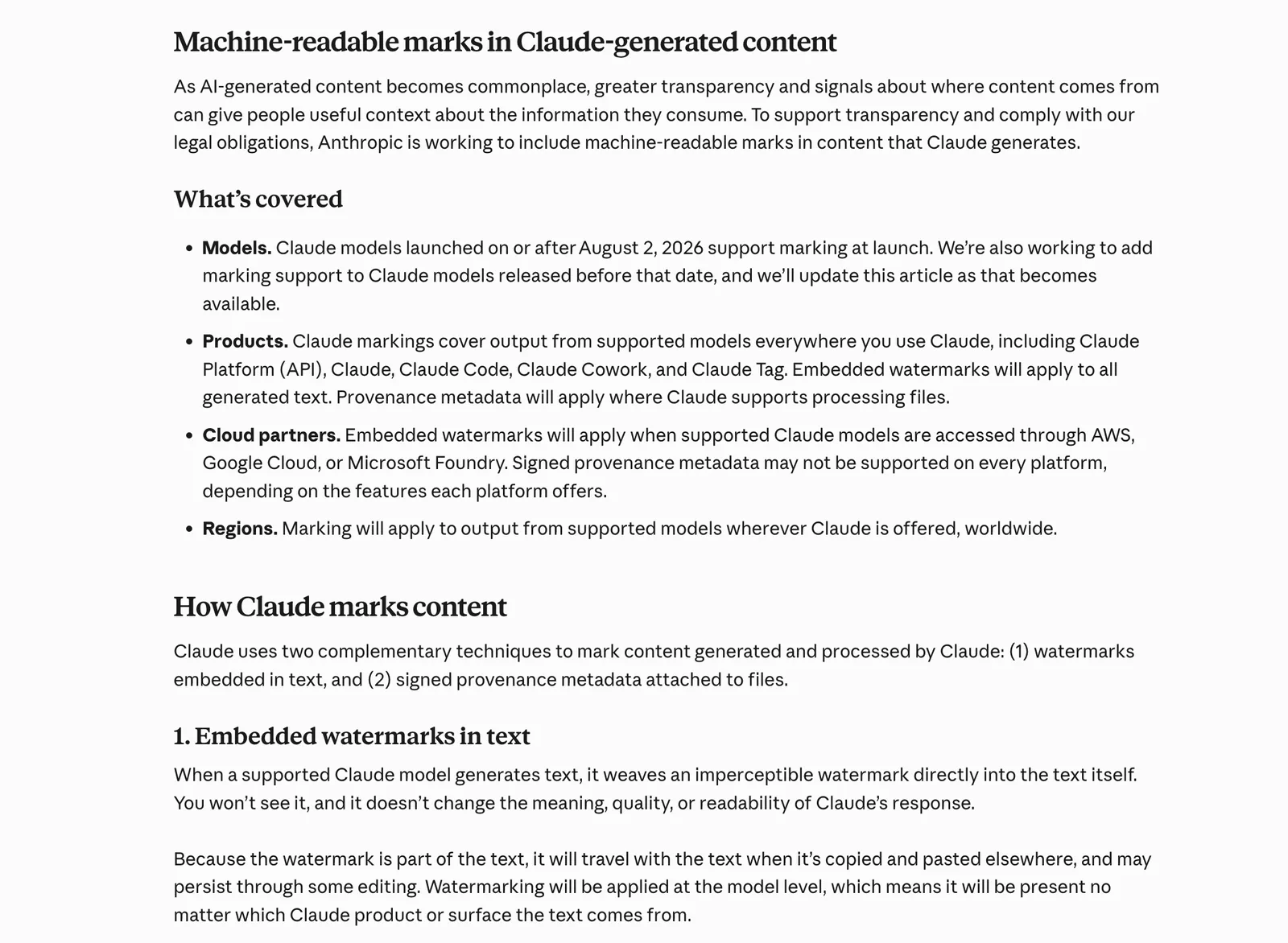
Anthropic's current documentation, How Claude marks AI-generated content, describes machine-readable marks designed to provide context about where content came from. The documentation says that Claude models launched on or after August 2, 2026 support marking at launch, with support for earlier models being added over time.
The marking applies at the model level rather than to one individual Claude interface. Anthropic says supported output can carry the mark through Claude, the API, Claude Code, Claude Cowork, Claude Tag, and supported cloud deployments. The same page separates text watermarking from provenance metadata for files.
How a Claude text watermark may work
Anthropic has not published the complete detection algorithm, secret key, or implementation details in the public documentation. That means no outside article can responsibly describe the exact Claude watermark formula as a confirmed fact.
We can still explain the general idea from established language-model watermarking research. During generation, a model chooses the next token from a probability distribution. A watermarking system can slightly change those choices according to a secret key, the preceding context, or another private rule. The change is small enough to preserve normal readability, but large enough to create a statistical pattern across enough text.
Research such as On the Reliability of Watermarks for Large Language Models and later work on paraphrasing robustness shows why this area is difficult. If the mark lives in the statistical choices made during generation, a font change or a file rename does not address it. A rewrite that generates a new sequence of words may change the signal, but the result depends on how much of the original text is changed and how the detector works.
Why copying can carry a mark
Anthropic's explanation says that the text watermark is part of the text itself. That is why it can travel when text is copied and pasted. This does not necessarily mean that the watermark is a hidden character such as a zero-width space. It may be a pattern in the model's word and token choices. A simple script that removes invisible Unicode characters can be useful for cleaning pasted text, but it is not a proven Claude watermark remover.
Why the mark may be difficult to notice
A useful watermark has to balance detectability with writing quality. If the changes are too obvious, the text becomes awkward. If the changes are too small, detection becomes less reliable, especially in short passages. The practical result is that a detector may need enough text before it can make a meaningful classification, and a positive mark should be treated as a signal about processing rather than absolute proof of authorship.
Claude text watermark vs. file provenance metadata
These two layers are often mixed together in online discussions. They should be handled separately.
| Layer | Where it lives | What may affect it |
|---|---|---|
| Embedded text watermark | Inside the language pattern of supported model output | Substantial editing, paraphrasing, translation, or re-generation may change it |
| Signed provenance metadata | Inside or alongside a supported document or file | Exporting, re-encoding, metadata stripping, or unsupported platforms may remove or break the record |
| AI detection score | A separate classifier or verification service | Model version, sample length, writing style, and detector design all matter |
The second row is related to C2PA, the open standard for content provenance. The C2PA specification describes signed manifests, assertions, content bindings, and validation. A missing or invalid manifest does not turn a file into proof of human authorship. It only means that the provenance record is missing, unavailable, or no longer verifiable.
Common Claude watermark removal methods
Several approaches are commonly discussed. They do not have the same effect, and none should be described as a universal solution.
1. Copying into a plain-text editor
Moving content through a plain-text editor can remove rich formatting, comments, and some application-specific data. It can also help clean accidental zero-width characters introduced by a copy operation. That is useful text hygiene.
It is not enough to conclude that a model-level statistical watermark has disappeared. If the mark is encoded in token choices, the same words remain after the formatting is removed. Plain-text cleanup is best treated as a formatting step, not a complete Claude text watermark removal method.
2. Stripping document metadata or exporting a new file
Re-exporting a PDF, Office file, or other supported format may remove a provenance manifest when the export tool does not preserve it. The same can happen when metadata is deliberately stripped. This changes the file layer, not necessarily the text inside it.
There is also a trade-off. Removing provenance makes it harder for a publisher or client to understand the document's history. If transparency matters, keep the original file and disclose the editing workflow instead of treating a metadata-free copy as an authorship certificate.
3. Manual rewriting
Manual editing is the most defensible way to make a Claude draft your own work. Add the reasoning, examples, constraints, and decisions that came from you. Replace broad claims with details you can support. Cut sentences that you would not say or cannot verify.
This process can change enough of the original text to affect a watermark detector, but that should be a side effect of genuine editing. Manual rewriting takes time, and it is still possible to preserve a signal in a long document if only a few sentences change.
4. AI paraphrasing or humanization
A paraphrasing system generates a new wording sequence instead of applying surface-level formatting changes. That is why AI humanizers are among the most discussed methods for changing text watermark signals. The same process can also introduce factual errors, flatten a writer's voice, or make a technical explanation less precise.
Ryter Pro is most useful here as an editing layer. It can help reorganize sentences, vary cadence, and replace machine-like phrasing. Afterward, read the output, compare it with the source, verify claims, and add your own judgment. The aim is a clearer document, not a promise that every detector will return a particular label.
Try the Ryter Pro text humanizer when you need to turn a rough AI-assisted draft into text that is easier to review and adapt.
5. Translation, back-translation, or OCR
Translating text into another language and back, running it through OCR, or retyping it can break the original sequence and remove file metadata. These methods are blunt. They can change terminology, punctuation, names, citations, and meaning. OCR can also introduce errors that are hard to see in a long document.
Use these operations only when they serve a real conversion need. They are poor substitutes for careful editing and should not be used to disguise material that a policy requires you to disclose.
What works best in practice
The strongest workflow treats Claude watermark removal as a content-quality problem first.
- Identify the layer. Decide whether you are dealing with plain text, a document's provenance metadata, or a separate AI detector score.
- Keep the original. Save the Claude draft, source notes, citations, and file version before making changes.
- Rewrite for meaning and ownership. Add your own examples, reasoning, limits, and decisions. Do not change technical terms just to make the wording look different.
- Use a humanizer as an editor. A tool such as Ryter Pro can provide a new draft, but the writer must check the result line by line.
- Test representative passages. Short samples can produce unstable results. Check more than one section and record the detector name, version, date, and word count.
- Follow disclosure rules. A clean text scan or missing metadata does not override school, client, employer, or publisher requirements.
Can Ryter Pro remove a Claude watermark?
Ryter Pro does not claim to decode Anthropic's private watermark key or certify that a document was written by a human. Its role is language-level rewriting. When it produces a substantially different draft, the new token sequence may not preserve the same Claude signal. Whether a detector still finds a mark depends on the input, the amount of rewriting, the detector's method, and future changes to the watermark system.
That is the honest reason to use Ryter Pro: it can help make AI-assisted writing more natural, specific, and readable while giving you a draft to review. It should not be marketed as a legal, academic, or forensic guarantee.
Frequently asked questions
Is the Claude watermark visible?
No. Anthropic describes it as an imperceptible watermark woven into supported text. Readers should not expect a visible label, symbol, or highlighted character.
Does copying Claude text into Notepad remove the watermark?
It may remove formatting and some hidden file or clipboard data, but there is no public basis for treating plain-text copying as a guaranteed removal of a model-level text watermark.
Does changing a PDF or Word file remove the Claude mark?
Exporting or stripping metadata can affect signed provenance information. It does not automatically rewrite the text, and a file without a valid provenance record is not proof of human authorship.
Can an AI humanizer guarantee a watermark-free result?
No. A substantial rewrite can change the statistical properties of the text, but no responsible tool can guarantee a result against an undisclosed or changing detector. Review for meaning and accuracy before publishing.
Should I disclose Claude assistance after rewriting?
Follow the rules that apply to your situation. A rewrite can change the wording, but it does not erase the fact that Claude was part of the workflow. When disclosure is required, keep the original draft and describe the role of the tool accurately.
Summary
Claude's new machine-readable marks involve two different systems: a watermark embedded in supported text and signed provenance metadata for supported files. Plain-text cleanup and metadata stripping may affect the file layer, but they do not prove that the text watermark is gone.
Manual editing and careful humanization are more meaningful because they change the language itself. Ryter Pro can help with that step, but the writer remains responsible for the final claims, voice, citations, and disclosure. The useful target is not a perfect invisibility promise. It is a document that is accurate, readable, traceable, and honest about how it was made.