

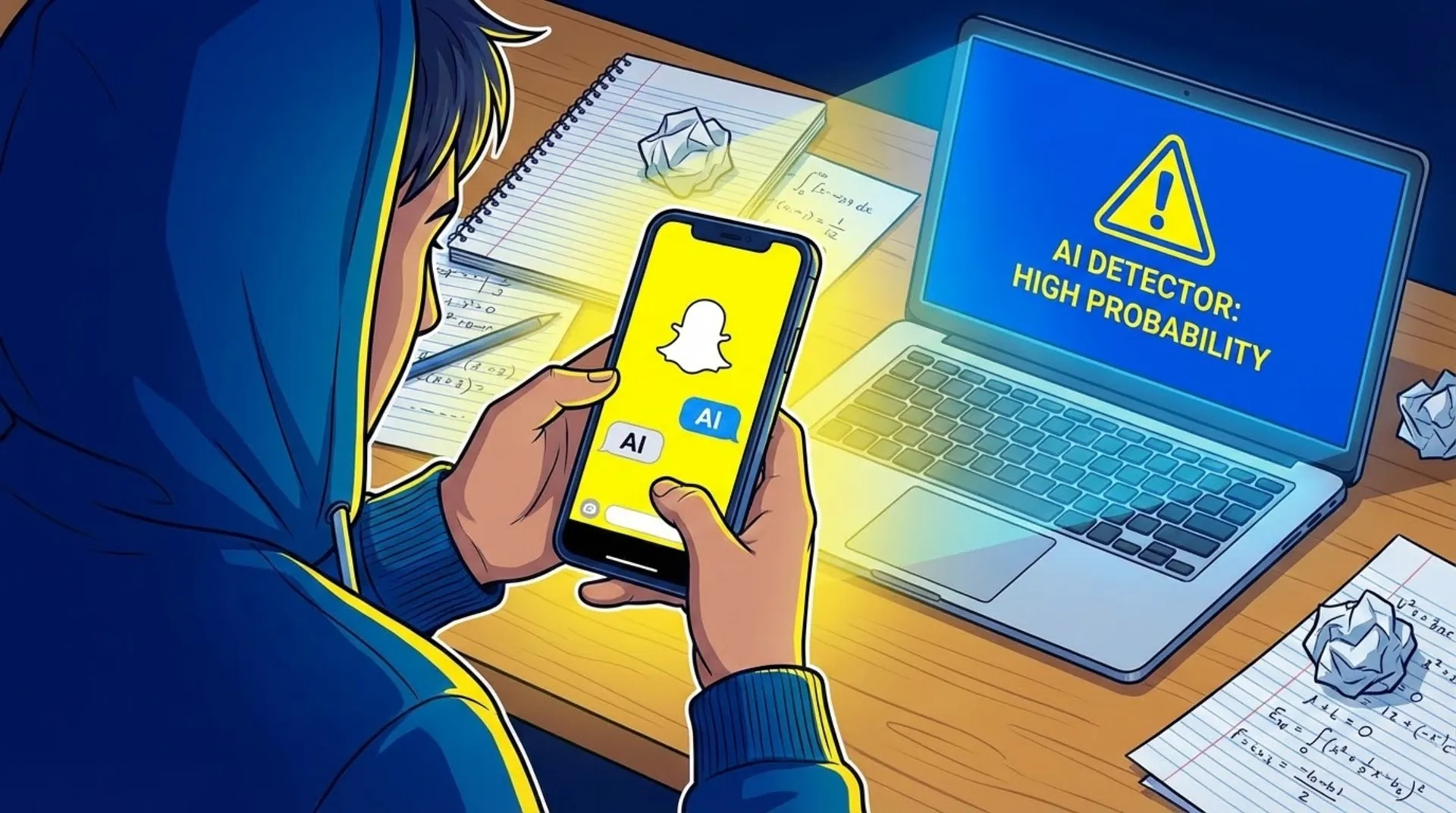
Millions of students use Snapchat's built-in chatbot, My AI, to draft essays, answer homework questions, and summarize readings. It's fast, discreet, and already on their phones. But the question that keeps students up at night is: can Snapchat AI be detected by teachers, Turnitin, or other academic integrity tools? The short answer is yes — but the full picture is more nuanced, and understanding it could save your academic career.
What Is Snapchat My AI?
Snapchat launched My AI in early 2023, powered by OpenAI's GPT-3.5 — the same underlying model that drives ChatGPT. Unlike ChatGPT, My AI lives inside an app students already use daily, making it far more accessible and less conspicuous than opening a dedicated AI writing tool. Students can ask it to write full essays, rewrite paragraphs, generate outlines, or summarize textbook chapters, all within a familiar chat interface.
Because My AI uses a conversational, casual tone by default, its output often reads slightly differently from generic ChatGPT text. This has led many students to believe that Snapchat AI cannot be detected — a dangerous assumption.
Can Snapchat AI Be Detected by Turnitin?
Yes. Turnitin's AI detection engine, updated significantly in 2024 and 2025, is trained on a broad corpus of AI-generated text including output from GPT-3.5, GPT-4, and social-media-style AI chatbots. When students ask whether can Snapchat AI be detected by Turnitin specifically, the data shows:
- Raw, unedited Snapchat AI output is flagged at roughly 50–60% accuracy — lower than generic ChatGPT (around 80%), but still a significant risk.
- Turnitin's 2025 v2.0 update improved detection of social-media AI datasets by approximately 25%, narrowing the gap.
- Lightly paraphrased AI text still triggers detection in many cases, especially when sentence structure and vocabulary patterns remain AI-typical.
- Heavily rewritten or humanized text can evade detection — but only if done correctly.
A UCLA study found that Turnitin correctly identified only about 34% of AI-generated content overall, which means false negatives are common. However, false positives also exist — human-written work has been incorrectly flagged, causing real academic harm to innocent students.
Can Teachers Detect Snapchat AI Without Tools?
Even without software, experienced teachers can often tell when something is off. Manual detection relies on pattern recognition built from years of reading student work. Common red flags include:
- Writing style that is noticeably more polished than a student's previous submissions
- Generic, overly structured arguments with no personal voice or specific examples
- Unusual vocabulary choices inconsistent with the student's known level
- Perfectly balanced paragraph lengths and formulaic transitions
- Lack of any factual errors — ironically, AI text is often suspiciously error-free
So when students wonder can Snapchat AI be detected by a human reader, the answer is: often yes, especially for teachers who know their students well.
The Real Risk: Academic Consequences
Over 40% of students have experimented with AI tools for schoolwork, according to recent surveys. The consequences of getting caught range from a failing grade on the assignment to full course failure, academic probation, or expulsion — depending on the institution's policy. Many universities have updated their academic integrity policies specifically to address AI-generated content, and the trend is toward stricter enforcement, not looser.
The safest approach is not to avoid AI entirely, but to use it responsibly — and to ensure that any AI-assisted writing is thoroughly humanized before submission.
How to Humanize AI Text and Reduce Detection Risk
If you've used Snapchat AI or any other AI tool to draft content, the key step is to humanize AI text before submitting it. This means rewriting it to reflect your own voice, adding personal examples, varying sentence structure, and removing the telltale patterns that detectors look for.
Doing this manually takes time and skill. A faster, more reliable option is to use a dedicated AI humanizer tool. Ryter Pro offers a powerful AI humanizer that transforms AI-generated text into natural, human-sounding writing that passes major detectors including Turnitin, GPTZero, and Copyleaks. The tool analyzes your text for AI patterns and rewrites it at a structural level — not just swapping synonyms — so the output genuinely reads as human-written.
You can also explore Ryter Pro's full suite of AI writing tools including AI detection, paraphrasing, and grammar checking — all designed to help you work smarter while staying academically safe.
Detection Tool Comparison: How They Handle Snapchat AI
Not all AI detectors are equal. Here's how the major tools perform when asked whether can Snapchat AI be detected:
- Turnitin: 50–60% detection rate for raw Snapchat AI output; improving with each update
- GPTZero: Trained heavily on GPT-family models; moderate accuracy on Snapchat AI's conversational style
- Copyleaks: Broad training data; comparable to Turnitin for social-media AI text
- Winston AI: Strong on formal academic AI text; slightly weaker on casual chatbot output
- Originality.ai: One of the more aggressive detectors; higher false positive rate but catches more AI content
The takeaway: no single detector catches everything, but using multiple tools together significantly increases the chance of detection. Schools are increasingly running submissions through more than one platform.
Frequently Asked Questions
Can Snapchat AI be detected by my school's plagiarism checker?
Yes, most modern plagiarism and AI detection tools — including Turnitin, Copyleaks, and GPTZero — can detect Snapchat AI output to varying degrees. Raw, unedited AI text carries the highest risk. Humanizing the text before submission significantly reduces detection probability.
Is Snapchat AI the same as ChatGPT?
Snapchat My AI is powered by OpenAI's GPT-3.5, the same underlying model as early versions of ChatGPT. However, it's tuned for a more casual, conversational tone, which can make its output slightly harder for detectors trained primarily on formal ChatGPT text. That said, the gap is narrowing as detectors update their training data.
Can Snapchat AI be detected if I edit the text myself?
Light editing — fixing a few words or sentences — is usually not enough to fool modern detectors. Structural AI patterns (sentence rhythm, paragraph balance, vocabulary distribution) persist even after surface-level edits. For reliable results, use a dedicated humanizer tool that rewrites at a deeper level.
Does Snapchat store my AI conversations?
Yes. Snapchat stores My AI conversations by default and may use them to improve the model. This is a separate privacy concern from academic detection, but worth knowing if you're using it for sensitive assignments.
What's the safest way to use AI for schoolwork?
Use AI as a brainstorming and drafting aid, not a final submission tool. Always rewrite AI output in your own voice, add specific examples from your own knowledge, and run the final text through a humanizer like Ryter Pro before submitting. Check your institution's AI policy — some schools allow AI assistance with disclosure.
Summary
So, can Snapchat AI be detected? Yes — by both automated tools and attentive teachers. Detection rates for raw Snapchat AI output range from 50–60% on Turnitin and are improving every year. The risk is real, and the academic consequences can be severe. The smart move is to treat AI as a starting point, not a finished product. Humanize your AI-generated text thoroughly, use tools built for the job, and always add your own voice and knowledge. Ryter Pro makes that process fast and reliable — so you can use AI confidently without the anxiety of detection.