Read the percentage as an estimate
A Compilatio score represents the portion of text that resembles AI writing. It is an indicator for review, not proof that a person used a particular tool.

Ryter helps you revise Compilatio-flagged passages for clearer structure, specific detail, and your own voice—then compare the same draft again.
Your humanized text will appear here
Click to bypass another AI detector
Read the report before you rewrite
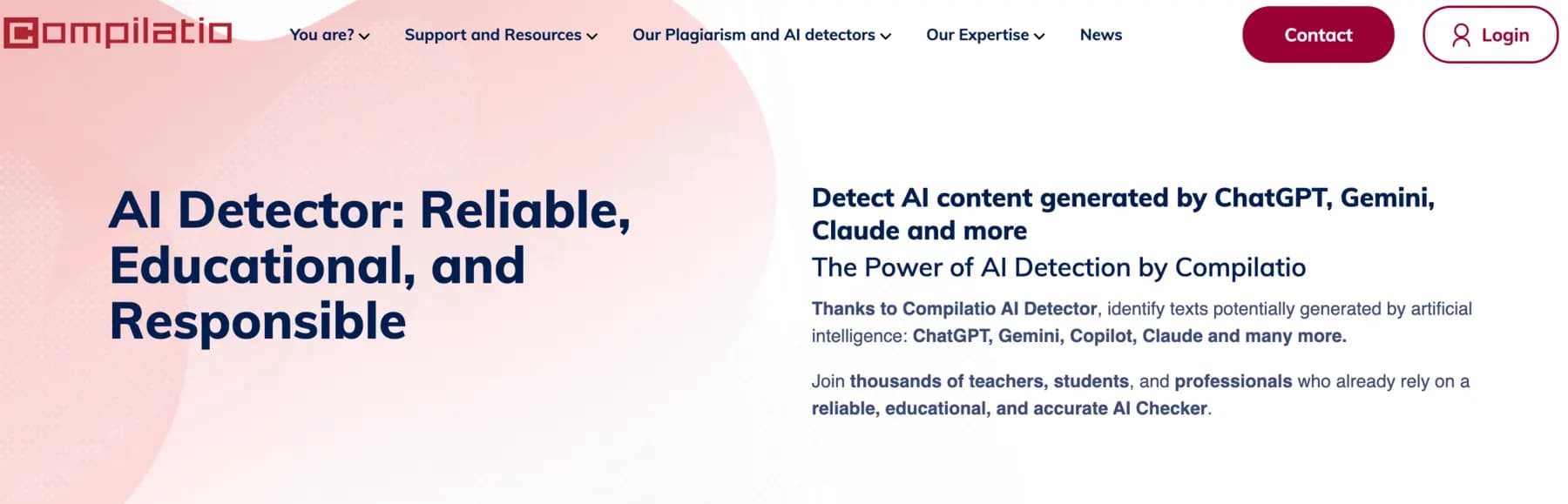
Compilatio presents its AI Detector as a tool for identifying passages that may resemble writing produced by generative AI, including systems such as ChatGPT, Gemini, Claude, and Copilot. Its report is designed to show an estimated percentage of potentially AI-generated text together with the location of passages that influenced the result. That makes the report useful as an editorial starting point, not a verdict about authorship: review the highlighted sections in context, compare them with the writer’s normal work and source notes, and keep the exact document version fixed when you rescan it.
A Compilatio score represents the portion of text that resembles AI writing. It is an indicator for review, not proof that a person used a particular tool.
The locations are more useful than the headline number alone. Check whether a flagged passage is generic, repetitive, unusually polished, or simply different from the surrounding voice.
Results can depend on the document length, language, content mix, and Compilatio solution being used. Compare like-for-like drafts and follow the policy that applies to the assignment or publication.
Product behavior and thresholds can change. Recheck the linked documentation and follow your school, client, or publisher’s AI-use policy. A detector result should support human review, not replace it.
How it works
Detector models use different proprietary signals. Use the current Compilatio report to identify passages that need a more specific, accurate, and genuinely personal rewrite.
Keep the original score and highlighted passages so you can compare the exact same document after editing.
Use your sources, examples, and intended argument to restore the details that make the writing genuinely yours.
Ryter reshapes sentence flow and tone while giving you a draft to review instead of a blind score-chasing edit.
Fact-check the final text, rescan the same version, and follow your institution or publisher’s AI-use policy.
Bypass Compilatio, keep it human
Use the Compilatio report as an editorial signal: preserve your evidence and meaning, make the language more specific to your experience, and compare the same complete draft after revision.
Why Ryter wins
Detector behavior changes over time. Ryter helps you edit for natural voice, factual accuracy, and readability, then verify the result in the review tool that matters to you.
Start with the passages Compilatio highlights, then revise the surrounding paragraph so the argument remains coherent.
Add the concrete reasoning, examples, and transitions that reflect the author’s real point of view.
Review every factual claim, quotation, and reference after rewriting instead of treating a lower score as success by itself.
Use the same complete draft before and after editing so the comparison remains useful across changing detector versions.
Why bother?
A reviewable Compilatio score should lead to better documentation and editing, not an automatic conclusion about authorship.
Specific examples, personal reasoning, and accurate source use make the final draft clearer to readers as well as reviewers.
Rescanning the same complete draft gives you a more meaningful before-and-after record than chasing a score on fragments.
What you get
Improve clarity and personal voice when a Compilatio result needs a closer human review.
Keep your evidence, terminology, and structure in view while revising flagged passages.
Retain the original draft, report, and final comparison for your own records or a reviewer’s questions.
Real teams
Review essays and research drafts against the assignment rules before handing in the final version.
Use highlighted passages to start a conversation about sources, revision history, and responsible AI use.
Make reports, articles, and customer-facing copy more specific without losing facts or brand context.
Compilatio bypass for all writing pros
Students
Review flagged essays while keeping the assignment requirements and your evidence in view.
Educators
Use report highlights as a starting point for a fair conversation, not a standalone accusation.
Editors
Improve specificity and continuity in drafts that need a documented human review.
Researchers
Protect terminology, citations, and technical meaning during revision.
Content teams
Turn generic AI-assisted drafts into more useful, accountable copy before publication.
Publishers
Keep an editable record of source checks and final-draft verification.
Real stories, real results with RyterPro
Emily Richards
College Student
“Ryter kept my thesis human while Compilatio showed <5% AI.”
John Parker
Marketing Specialist
“Campaign copy felt natural and still passed every Compilatio scan.”
Maria Gomez
Freelance Writer
“Clients that ban AI can’t tell my text started with a model.”
David Wilson
Data Analyst
“Technical memos stayed precise—Ryter only changed rhythm, not facts.”
Sarah Martinez
Literature Major
“No more late-night rewrites. Ryter keeps my style but removes AI traces.”
Mark Anderson
Academic Researcher
“Detector alerts vanished, and reviewers praised the clarity.”
FAQ
More tools you'll love
Request full PDF reports when you need human QA plus automated checks.
Explore →Automate detector-safe rewrites inside your pipeline using our REST API.
Explore →Paste the draft above, review every factual change, and rescan the final version in Compilatio. Scores are probabilistic, so keep human judgment and your applicable AI-use policy in the loop.
Humanize my content